


Are Both Testicles Supposed to Be at the Same Level? What Parents Should Know
Parents sometimes notice that their son’s testicles are not positioned at exactly the same height. Adult men may also observe that one testicle hangs slightly lower than the other. This can create unnecessary worry, especially when the difference is noticed for the first time.
In most cases, having testicles at different levels is completely normal. The testicles do not need to be perfectly aligned or positioned at the same height.
However, certain changes—such as sudden pain, swelling, redness, a new lump or a testicle that cannot be felt inside a child’s scrotum—should be evaluated by a doctor.
Watch our video on: Are Both Testicles Supposed to Be at the Same Level?
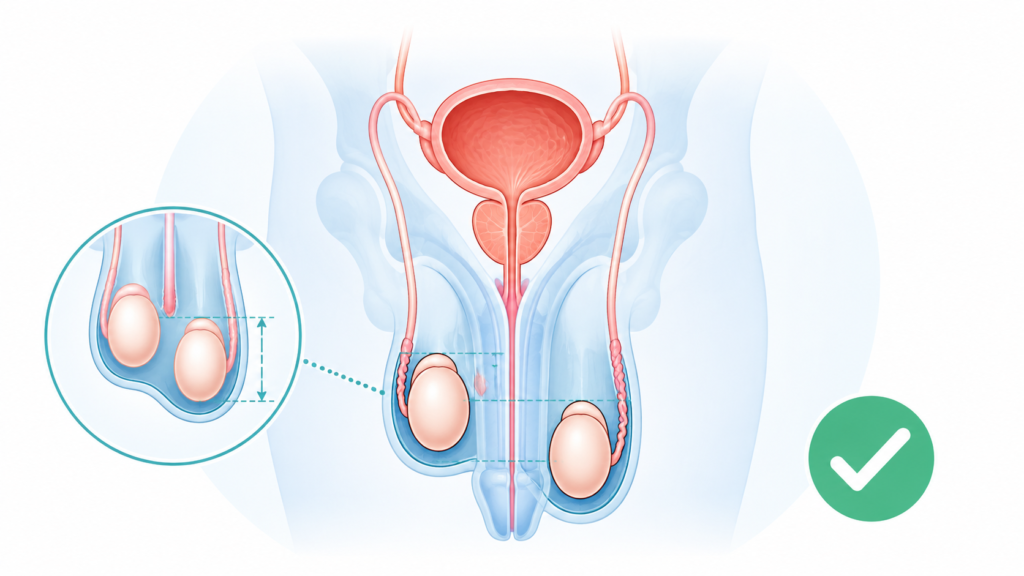
Is It Normal for One Testicle to Hang Lower?
Yes. It is common for one testicle to hang slightly lower than the other. In many boys and adult men, the left testicle sits lower, although normal anatomy can vary from person to person.
This natural difference allows the testicles to sit comfortably without being pressed directly against each other. A small difference in their position, size or orientation is generally not a sign of a medical problem.
The position of the testicles can also change temporarily because of:
- Cold or warm temperatures
- Physical activity
- Fear or stress
- Touching the inner thigh
- The natural cremasteric muscle reflex
- Changes in body position
In cold temperatures, the muscles around the testicles may pull them closer to the body. In warmer conditions, the scrotum relaxes, causing the testicles to hang lower.
Therefore, parents may notice that their child’s testicles appear lower at certain times and move upwards at other times.
Why Are the Testicles Positioned Outside the Body?
The testicles produce sperm and the hormone testosterone. They are located inside the scrotum, outside the main abdominal cavity, because sperm production requires a temperature slightly lower than the body’s internal temperature.
The scrotum helps regulate this temperature by moving the testicles closer to or farther away from the body.
Two important muscles assist with this process:
Cremaster Muscle
The cremaster muscle can raise or lower a testicle. It may contract in response to cold, touch, fear or physical activity.
Dartos Muscle
The dartos muscle tightens or relaxes the skin of the scrotum to help control temperature.
Because these muscles continuously respond to the surroundings, the position of the testicles may not always look the same.
What Is a Retractile Testicle?
A retractile testicle is a testicle that moves temporarily between the scrotum and the groin. This commonly happens because of an active cremasteric reflex.
The testicle may be visible or felt in the scrotum when the child is relaxed or warm but move upward when the child is cold, anxious or being examined.
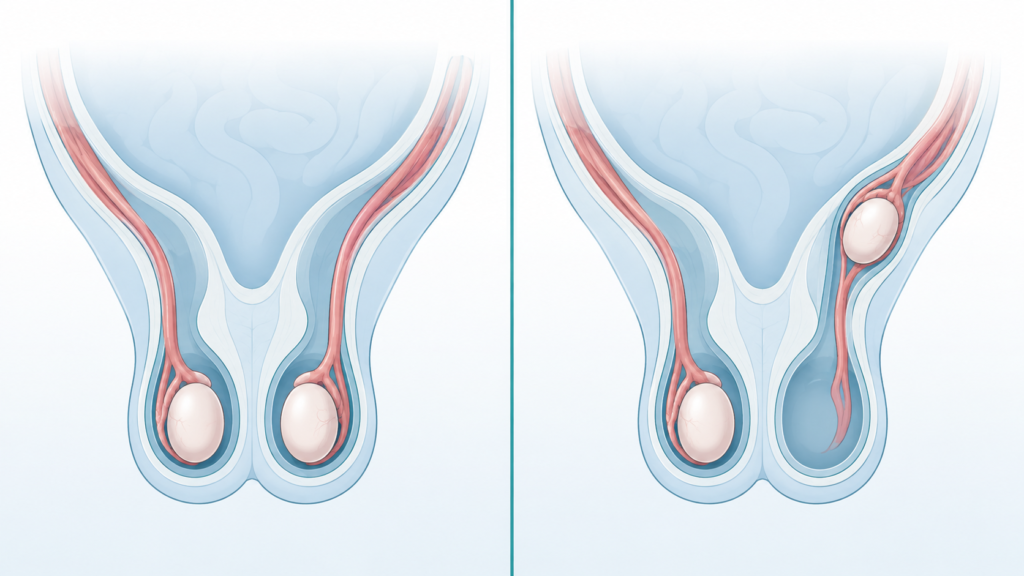
A retractile testicle is different from an undescended testicle. A doctor should examine the child to determine whether the testicle is retractile, undescended or has moved upwards permanently.
Retractile testicles often do not require surgery, but periodic medical examination may be recommended to monitor their position. The American Academy of Pediatrics explains that retractile testicles may sometimes be present in the scrotum and absent at other times because of this muscle reflex.
What Is an Undescended Testicle?
An undescended testicle occurs when one or both testicles have not moved into the scrotum as expected.
Parents may notice:
- One side of the scrotum looks empty
- A testicle cannot be felt inside the scrotum
- The scrotum appears smaller on one side
- One testicle remains near the groin
- The testicle was previously felt but no longer stays in the scrotum
An undescended testicle should not be ignored, even when the child has no pain. A paediatrician or paediatric surgeon should evaluate the child and recommend the appropriate next step.
A physical examination is usually the first step. Imaging is not automatically required in every case; the treating doctor will decide whether further investigation is necessary.
When Should Uneven Testicle Position Be Checked?
A mild and long-standing difference in height is usually normal. Medical evaluation is recommended when the uneven position is accompanied by other symptoms or represents a new change.
Consult a doctor if you notice:
- A testicle that cannot be felt in a child’s scrotum
- A new lump or hard area
- Persistent pain or discomfort
- Swelling or redness
- A sudden change in the position of a testicle
- One testicle becoming noticeably larger or smaller
- A feeling of heaviness in the scrotum
- Swelling in the groin
- Fever or urinary symptoms accompanying scrotal discomfort
Even a painless new lump should be medically evaluated. An examination can help distinguish harmless anatomical differences from conditions requiring treatment.
Sudden Testicular Pain Is an Emergency
Sudden and severe testicular or scrotal pain requires immediate medical attention. It may be caused by testicular torsion, a condition in which the testicle twists and its blood supply becomes restricted.
Possible warning signs include:
- Sudden, intense testicular pain
- Rapid swelling
- Nausea or vomiting
- Abdominal or groin pain
- One testicle appearing unusually high
- Redness or tenderness of the scrotum
Testicular torsion must be treated urgently to protect the affected testicle. Do not wait for the pain to settle and do not delay emergency care to arrange a routine scan
When Is a Scrotal Ultrasound Recommended?
A doctor may recommend a scrotal ultrasound scan when there is pain, swelling, a lump, an apparent difference in testicular size or another abnormal finding during examination.
Scrotal ultrasound uses sound waves to produce images of the testicles and surrounding structures. Doppler ultrasound may also be used to assess blood flow.
It can help doctors evaluate conditions such as:
- Testicular torsion
- Varicocele or enlarged scrotal veins
- Hydrocele or fluid around a testicle
- Epididymal inflammation
- Infection
- Cysts
- Testicular injury
- Testicular masses
- Differences in testicular size
- Blood flow abnormalities
Ultrasound does not use ionising radiation and is generally painless. However, it should be performed based on a doctor’s clinical advice rather than solely because one testicle naturally hangs lower. Ultrasound can provide information about the size, location and nature of a scrotal abnormality.
Scrotal Ultrasound at Nisarga Diagnostics
If your doctor recommends a scrotal ultrasound scan in Bangalore, Nisarga Diagnostics provides ultrasound evaluation at its diagnostic centre in Sanjaynagar.
The scan can help assess the testicles, epididymis, scrotal contents and blood flow when clinically required. Nisarga Diagnostics also uses scrotal ultrasound for evaluating conditions such as varicocele, based on the patient’s symptoms and medical referral. Nisarga Diagnostics
Patients should bring:
- The doctor’s prescription
- Previous scan reports, if available
- Details of current symptoms
- Relevant medical or surgical records
The ultrasound findings must be interpreted together with the doctor’s physical examination and clinical assessment.
Frequently Asked Questions
Do both testicles have to be the same height?
No. It is normal for the testicles to hang at slightly different heights. One testicle—commonly the left—may sit lower than the other.
Is one testicle lower than the other in children normal?
A slight difference can be normal. However, if one testicle cannot be felt inside the scrotum, the child should be examined by a doctor.
Can the position of a testicle change?
Yes. Temperature, activity and the cremasteric reflex can temporarily move a testicle upwards or downwards.
Does uneven testicle position affect fertility?
A normal difference in height does not generally affect fertility. Fertility may be affected by certain underlying conditions, such as varicocele, infection, testicular injury or an untreated undescended testicle.
Is an ultrasound needed if one testicle hangs lower?
Not usually when the difference is mild, long-standing and there are no other symptoms. A doctor may advise ultrasound if there is pain, swelling, a lump, a change in size or another concerning finding.
The Takeaway
Testicles are not expected to hang at exactly the same level. A slight difference in position is a common anatomical variation in both boys and adult men and usually does not require treatment.
However, a missing testicle in a child, a new lump, swelling, persistent discomfort or an unusual change should be checked by a doctor. Sudden severe testicular pain must be treated as a medical emergency.
If your treating doctor recommends imaging, a scrotal ultrasound scan at Nisarga Diagnostics in Sanjaynagar, Bangalore, can provide detailed information about the testicles, surrounding structures and blood flow.

Founder of Nisarga Diagnostics, is a renowned fetal ultrasound specialist with over 20 years of expertise. An alumnus of Government Medical Colleges in Mysore and Bangalore, he also holds a D.N.B. from the National Board of Examinations, Delhi, and certification from the Fetal Medicine Foundation, London. A former Professor and HOD, he has trained countless PG students and junior radiologists, shaping the future of fetal imaging in India.