



Quadruple Marker Test in Pregnancy

Quadruple Marker Test in Pregnancy

Watch our video on : Importance of this Test in Pregnancy

Pregnancy is a beautiful journey filled with excitement, care, and regular medical check-ups. In addition, one of the most important aspects of prenatal care is screening tests that help monitor the baby’s health and development. Among these, the Quadruple Marker Test plays a crucial role in identifying the risk of genetic abnormalities during pregnancy.

At Nisarga Diagnostics, Bangalore, advanced prenatal screening tests like the Quadruple Marker Test are conducted with high accuracy and expert guidance to ensure both mother and baby remain safe and healthy throughout pregnancy.

What is the Quadruple Marker Test?

It is a blood test performed during pregnancy to assess the risk of certain genetic and chromosomal abnormalities in the developing baby. Specifically, it measures the levels of four important substances (markers) present in the mother’s blood. It measures the levels of four specific substances (markers) present in the mother’s blood:

  • Alpha-fetoprotein (AFP)

  • Human Chorionic Gonadotropin (hCG)

  • Estriol (uE3)

  • Inhibin A

Therefore by analyzing these four markers along with the mother’s age, weight, and gestational age, doctors can estimate the probability of conditions such as:
  • Down Syndrome (Trisomy 21)

  • Trisomy 18

  • Neural Tube Defects

It is important to understand that the Quadruple Marker Test is a screening test, not a diagnostic test. It only indicates risk levels and not a confirmed diagnosis.

Quadruple Marker Test

When Should this Test to Be Done?

Firstly, timing is extremely important for the accuracy of this test. Ideally, the Quadruple Marker Test should be performed between 15 and 20 weeks of pregnancy. Most importantly, it is most accurate around 16 to 18 weeks.

The ideal time to perform the Quadruple Marker Test is:

  • Between 15 weeks and 20 weeks of pregnancy

  • Most accurate around 16 to 18 weeks

  • Not recommended before 15 weeks

  • Cannot be done after 20 weeks and 6 days

At Nisarga Diagnostics, experienced professionals ensure that the test is scheduled at the correct gestational window for reliable results and proper interpretation.

Why is this Test Recommended?

Quadruple Marker Test
  • Many pregnant women undergo NT scan and Double Marker Test in the first trimester. However, if those results show high risk or borderline risk, doctors may recommend this test as a second-trimester screening. Additionally, it is advised if early screening was missed.

  • High risk

  • Borderline risk

  • Or if early screening was missed

Doctors may recommend the this Test as a second-trimester screening.

This test is especially important for:

  • Women above 30–35 years

  • Previous history of genetic disorders

  • Abnormal first-trimester screening results

  • Missed Double Marker Test

  • Family history of chromosomal abnormalities

Early risk detection helps parents and doctors plan further evaluation and care in a timely manner

How is this Test Done?

The procedure is simple, safe, and non-invasive.

Step-by-step process:

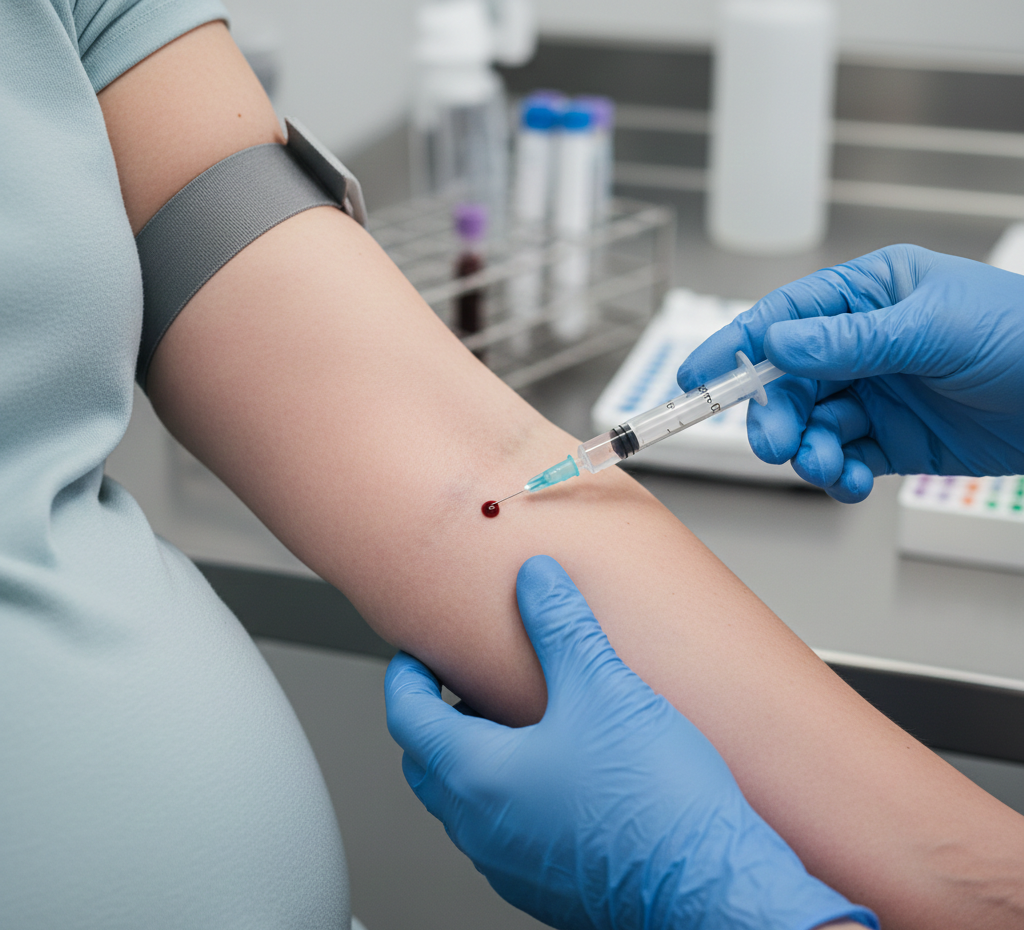
  1. A small blood sample is collected from the mother’s arm

  2. The sample is sent to a specialized laboratory

  3. Hormone and protein levels are measured

  4. Risk calculation is done using medical algorithms

  5. A detailed report is generated

The test does not harm the baby and does not require fasting or special preparation.

Quadraple marker test

What Do this Test Results Mean?

The Quadruple Marker Test report usually shows risk levels categorized as:

  • Low Risk

  • Intermediate Risk

  • High Risk

Low Risk Result

This means the probability of genetic abnormalities is low. Routine pregnancy care can continue as advised by your doctor.

High Risk Result

A high-risk result does NOT confirm that the baby has a genetic condition. It only indicates a higher probability. Doctors may recommend further diagnostic tests such as:

  • NIPT (Non-Invasive Prenatal Testing)

  • Amniocentesis

  • Detailed anomaly scan

Proper counselling and expert guidance are very important after receiving the report.

Quadruple Marker Test vs Double Marker Test

Many parents get confused between these two tests.

Feature Double Marker Test Quadruple Marker Test
Trimester First Trimester Second Trimester
Weeks 11–14 weeks 15–20 weeks
Markers Checked 2 4
Purpose Early screening Additional risk screening

If the Double Marker Test shows low risk, the Quadruple Marker Test may not be necessary. However, if early screening is missed, this test becomes very valuable.

Is this Test Accurate?

The Quadruple Marker Test provides a reliable risk assessment when done at the correct time and interpreted by experts. However, it is not 100% diagnostic.

Factors affecting accuracy:

  • Correct gestational age

  • Maternal age

  • Multiple pregnancy

  • Diabetes or other medical conditions

That is why choosing a trusted diagnostic centre like Nisarga Diagnostics is essential for accurate reporting and proper interpretation.

Who Should Not Miss this Test?

You should not skip the Quadruple Marker Test if:

  • You missed first-trimester screening

  • You are in the second trimester

  • Your doctor has advised additional genetic screening

  • You want reassurance about your baby’s genetic health

Ignoring recommended screening tests can delay the detection of potential complications.

Conclusion

In conclusion, the Quadruple Marker Test is an important second-trimester screening test that helps assess the risk of genetic abnormalities and neural tube defects in the baby. Although it does not provide a confirmed diagnosis, it offers valuable insights for further medical decisions. Therefore, timely testing and expert interpretation are essential for a safe and well-monitored pregnancy.

Leave a Comment

Your email address will not be published. Required fields are marked *