


Water in Baby Kidney During Pregnancy Scan
During pregnancy, ultrasound scans help doctors monitor the growth and development of the baby. Sometimes parents become worried when a scan report mentions water in baby kidney during pregnancy scan.
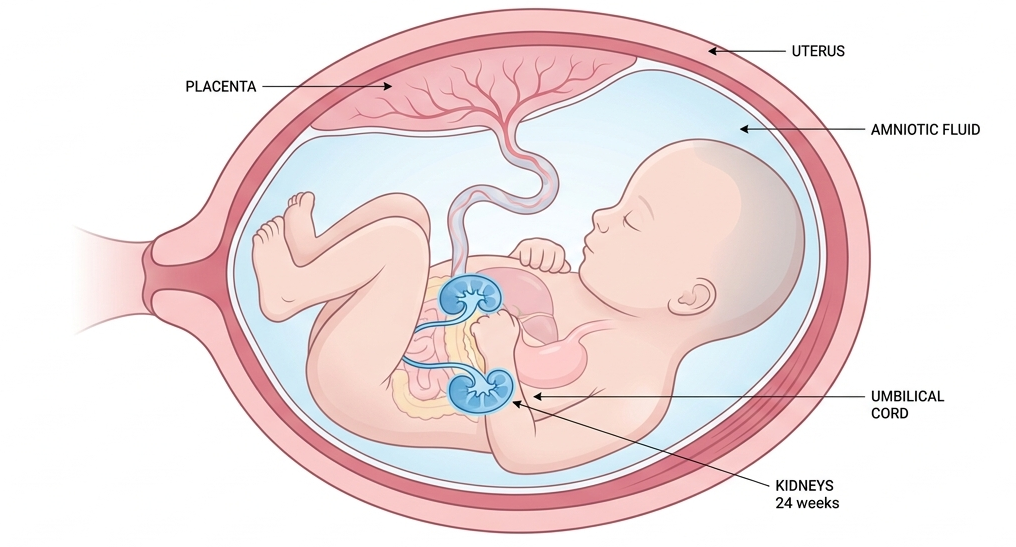
This condition is medically referred to as Fetal Pelvic Ectasia or Fetal Hydronephrosis. It means that a small amount of urine is collecting in the baby’s kidney.
Seeing this in a scan report can cause anxiety for many parents, but the good news is that in most cases it is mild and resolves on its own as the pregnancy progresses.
At Nisarga Diagnostics, advanced pregnancy scans help doctors carefully monitor fetal development and detect such conditions early so that proper follow-up can be planned if needed.
Watch our video on : Water in Baby Kidney During Pregnancy Scan.
Understanding Water in Baby Kidney During Pregnancy Scan
To understand water in baby kidney during pregnancy scan, it is important to know how the baby’s urinary system develops.
The baby’s kidneys start producing urine during pregnancy. This urine flows through a tube called the ureter and collects in the urinary bladder before being released.
Sometimes, the flow of urine from the kidney to the bladder becomes slightly slow or temporarily blocked. When this happens, a small amount of urine may collect in the kidney, which appears as fluid or water in the kidney on ultrasound.
This is what doctors refer to as fetal pelvic ectasia.
In most pregnancies, this is a temporary developmental change and not a serious disease.
Why Does Water Collect in the Baby’s Kidney?
There can be several reasons why water in baby kidney during pregnancy scan is detected.
Temporary Urine Flow Delay
In many babies, the urinary tract is still developing. A temporary delay in urine flow can lead to mild fluid collection in the kidney.
Mild Ureter Narrowing
Sometimes the ureter may be slightly narrow during development, which slows down the urine flow.
Pressure from the Growing Uterus
As pregnancy progresses, the growing uterus may sometimes influence urine drainage temporarily.
Developmental Variation
Many babies naturally show mild pelvic dilation during growth, which later resolves before or after birth.
Most of these causes do not require treatment during pregnancy, but they require monitoring through ultrasound scans.
Can Food or Lifestyle Reduce Water in Baby Kidney?
One of the most common questions parents ask after seeing water in baby kidney during pregnancy scan is whether diet or lifestyle changes can reduce it.
The important thing to understand is that:
This condition cannot be reduced by food, exercise, or home remedies during pregnancy.
It is related to the baby’s urinary system development, and therefore monitoring through regular scans is the recommended approach.
Parents should avoid unnecessary stress and simply follow the doctor’s advice.
Measurement Levels and Their Meaning
Doctors usually measure the renal pelvis diameter during ultrasound to determine how significant the condition is.
Mild Condition (Around 4 mm)
If the measurement is about 4 mm, it is generally considered mild.
Most babies with mild dilation show complete resolution before birth or shortly after birth.
Doctors may simply recommend routine follow-up scans to check whether the measurement remains stable or improves.
Moderate Condition (Around 7–10 mm)
If the measurement increases slightly, doctors may monitor the baby more carefully through regular ultrasound scans.
In many cases, even moderate dilation improves as the baby grows.
Severe Condition (More Than 10 mm)
If the measurement is greater than 10 mm, doctors may recommend closer monitoring.
In rare situations, pediatric specialists may evaluate the baby after birth to ensure the urinary tract functions properly.
However, it is important to remember that severe cases are uncommon.
How Doctors Monitor This Condition
When water in baby kidney during pregnancy scan is detected, doctors usually recommend periodic ultrasound scans to track changes.
Follow-up scans help doctors check:
Whether the kidney dilation is increasing
Whether both kidneys are functioning normally
Whether the bladder appears normal
Whether the amniotic fluid level is normal
These factors help doctors determine whether the condition is stable, improving, or requires further monitoring.
At Nisarga Diagnostics, detailed fetal ultrasound imaging helps provide accurate measurements so that doctors can plan appropriate follow-up care.
When Should Parents Be Concerned?
Parents should stay calm because most cases are mild. However, doctors may advise closer monitoring if:
Kidney dilation increases significantly
Both kidneys are affected
The bladder appears enlarged
Amniotic fluid levels are abnormal
Regular follow-up scans help doctors ensure the baby continues to develop normally.
Conclusion
Seeing water in baby kidney during pregnancy scan in a report can worry many parents, but in most cases it is a mild and temporary condition.
If the measurement is small, it usually resolves naturally as the baby grows. Regular follow-up scans help doctors monitor the condition and ensure the baby’s urinary system develops normally.
Parents should remember that this condition cannot be reduced by diet or lifestyle changes during pregnancy, and the best approach is to follow the doctor’s guidance and attend recommended scans.
Modern ultrasound technology and expert fetal monitoring ensure that such conditions are carefully observed so that both mother and baby remain safe throughout the pregnancy.

Founder of Nisarga Diagnostics, is a renowned fetal ultrasound specialist with over 20 years of expertise. An alumnus of Government Medical Colleges in Mysore and Bangalore, he also holds a D.N.B. from the National Board of Examinations, Delhi, and certification from the Fetal Medicine Foundation, London. A former Professor and HOD, he has trained countless PG students and junior radiologists, shaping the future of fetal imaging in India.

