

IUGR During Pregnancy: Causes, Diagnosis and the Role of Doppler Scans
Being told that your baby is measuring smaller than expected can naturally cause concern. However, a small measurement does not always mean that something is wrong.
Some babies are constitutionally small because of their parents’ body build. Others may not be growing as expected because they are not receiving enough oxygen or nutrients through the placenta. Growth scans and Doppler scans help doctors understand the difference.
In this article, we explain IUGR during pregnancy, how it is diagnosed and why regular monitoring is important.
Watch our video on: Do Twins Have the Same Heartbeat?
What Is IUGR During Pregnancy?
IUGR stands for Intrauterine Growth Restriction. It describes a condition in which a baby is not growing as well as expected inside the uterus.
The condition is now also commonly called Fetal Growth Restriction (FGR).
During a growth scan, the sonologist measures different parts of the baby, including:
- Head circumference
- Abdominal circumference
- Femur or thigh-bone length
- Biparietal diameter, which measures the width of the baby’s head
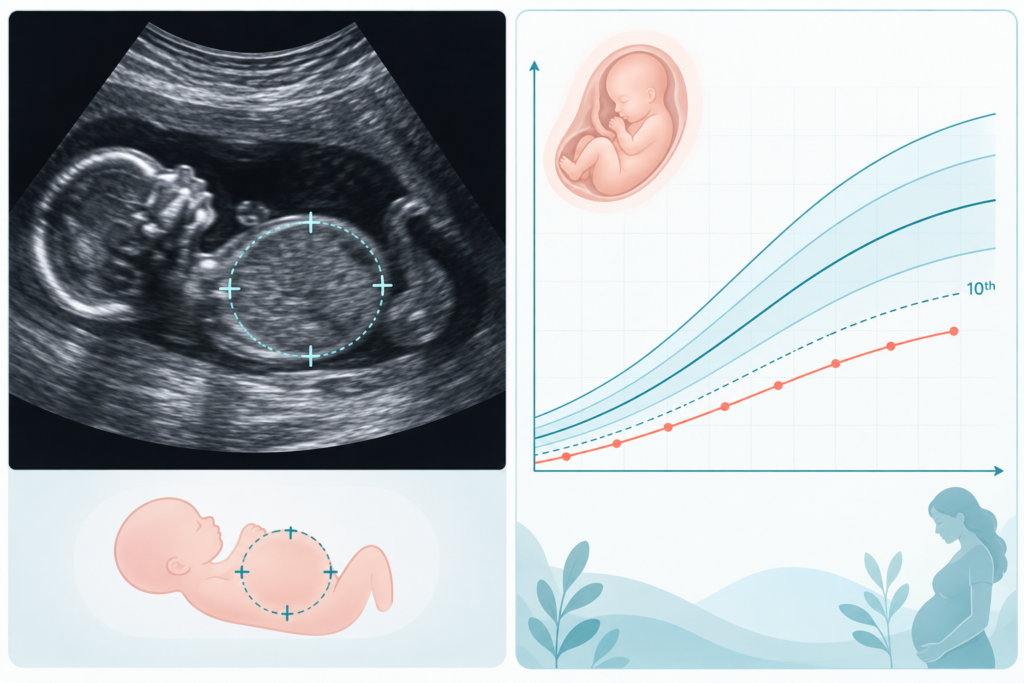
These measurements are used to calculate the baby’s estimated fetal weight (EFW). The result is then compared with the expected weight of babies at the same gestational age.
An estimated fetal weight or abdominal circumference below the 10th percentile may indicate that the baby is small and requires further assessment. However, being below the 10th percentile does not automatically mean that the baby has a serious growth problem.
What Does “Below the 10th Percentile” Mean?
A percentile shows how a baby’s estimated size compares with other babies at the same stage of pregnancy.
For example, if the baby’s estimated weight is at the 10th percentile, it means that approximately 10 out of 100 babies of the same gestational age may weigh less, while approximately 90 may weigh more.
Doctors do not usually depend on one measurement alone. They also assess:
- Whether the pregnancy has been dated correctly
- The baby’s previous growth measurements
- Whether the baby is continuing to grow between scans
- Placental blood flow
- Amniotic fluid levels
- The mother’s health
- The baby’s movements and overall well-being
The Society for Maternal-Fetal Medicine defines fetal growth restriction as an estimated fetal weight or abdominal circumference below the 10th percentile. However, doctors must interpret this finding together with the complete clinical and ultrasound assessment.
Is Every Small Baby Affected by IUGR?
No. A baby can be small but healthy.
Some babies are naturally smaller because one or both parents are petite. These babies may remain on a lower percentile while continuing to grow steadily, with normal Doppler findings and adequate amniotic fluid.
This is often described as a constitutionally small or small-for-gestational-age baby.
True fetal growth restriction means that something may be preventing the baby from reaching their expected growth potential. Abnormal placental blood flow, reduced amniotic fluid or a significant fall across growth percentiles may increase the concern.
Therefore, the 10th-percentile measurement should be viewed as a signal for further assessment rather than as a final diagnosis by itself.
What Causes IUGR During Pregnancy?
There are several possible causes of IUGR. In many cases, it is associated with the placenta not functioning as efficiently as expected.
Placental causes
The placenta supplies oxygen and nutrients to the baby. If placental function is reduced, the baby may not receive everything needed for optimal growth.
Maternal health conditions
Conditions that may increase the risk include:
- High blood pressure during pregnancy
- Preeclampsia
- Chronic kidney disease
- Certain heart conditions
- Severe anaemia
- Autoimmune disorders
- Poorly controlled diabetes with vascular complications
- Smoking, alcohol or substance exposure
- Significant maternal undernutrition
Fetal factors
In some pregnancies, growth restriction may be associated with:
- Chromosomal conditions
- Certain congenital abnormalities
- Some infections during pregnancy
- Multiple pregnancy, such as twins or triplets
Having one of these risk factors does not necessarily mean that the baby will develop IUGR. Similarly, IUGR can occasionally occur without an obvious cause. High blood pressure and preeclampsia can sometimes affect placental function and fetal growth. Learn more about how high blood pressure during pregnancy affects the baby’s growth.
How Is IUGR Diagnosed?
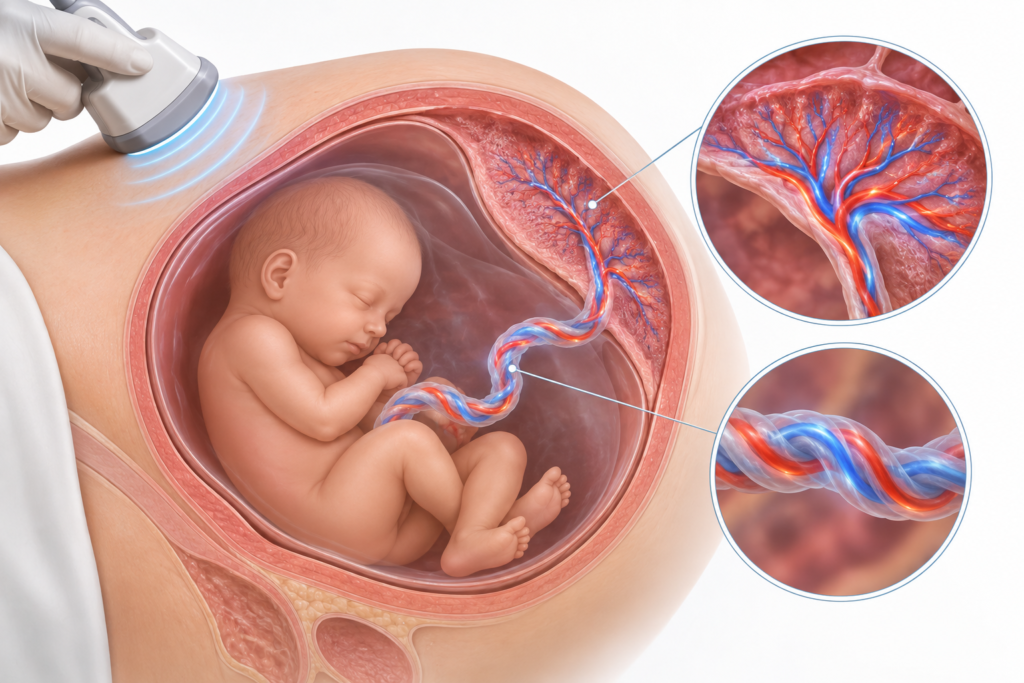
IUGR during pregnancy is generally assessed through an ultrasound growth scan combined with the mother’s medical and pregnancy history. Because the umbilical cord carries oxygen and nutrients between the placenta and the baby, assessing its blood flow can be important when fetal growth restriction is suspected. Read more about the importance of the umbilical cord during pregnancy.
Growth scan
A growth scan measures the baby’s head, abdomen and femur. These measurements are used to calculate the estimated fetal weight and plot it on an appropriate growth chart.
Serial growth scans
One scan provides information about the baby’s size at that particular time. Repeat scans help determine whether the baby is continuing to grow steadily.
A change in the baby’s growth pattern can sometimes be more informative than a single percentile measurement.
Amniotic fluid assessment
The scan also measures the amount of amniotic fluid surrounding the baby. Reduced fluid may occasionally be associated with placental insufficiency or fetal growth restriction.
Doppler scan
A fetal Doppler scan evaluates blood flow through important vessels, particularly the umbilical artery. Depending on the clinical situation, the doctor may assess additional fetal or maternal vessels.
The Doppler findings help doctors understand how efficiently blood is flowing between the placenta and the baby.
Why Is a Doppler Scan Important in IUGR?
A baby’s size alone cannot provide a complete picture of their well-being.
A Doppler scan can help assess:
- Resistance to blood flow in the placenta
- Blood flow through the umbilical cord
- Whether the baby may be adapting to reduced oxygen or nutrition
- Whether closer monitoring may be required
- The appropriate timing of the next scan
- Whether the pregnancy can safely continue under observation
According to the International Society of Ultrasound in Obstetrics and Gynecology, Doppler findings play an important role in planning follow-up and monitoring babies affected by IUGR.
A normal Doppler result can be reassuring, but continued monitoring may still be recommended because fetal growth and placental function can change as pregnancy progresses.
What Happens If IUGR Is Suspected?
The follow-up plan depends on:
- How small the baby is
- The gestational age
- Whether the baby’s growth is continuing
- Doppler scan results
- Amniotic fluid levels
- The mother’s blood pressure and health
- The baby’s movements
- Results of any additional monitoring
Your doctor may recommend:
- Repeat growth scans
- Umbilical artery Doppler assessment
- Blood-pressure monitoring
- Monitoring of fetal movements
- Non-stress tests or cardiotocography when appropriate
- Additional specialist evaluation
- Planning delivery at the safest time
The frequency of monitoring is personalised. Some mothers may require scans every few weeks, while others may need more frequent assessment.

Can IUGR Be Treated?
There is no single treatment that can immediately make a growth-restricted baby gain weight inside the uterus.
Management focuses on:
- Identifying and managing maternal health conditions
- Monitoring the baby’s growth and blood flow
- Watching for signs that the placenta is not functioning adequately
- Choosing the safest time for delivery
Mothers should continue following their obstetrician’s advice regarding nutrition, medications, activity and scheduled appointments. Bed rest, supplements or medicines should not be started specifically for IUGR unless advised by the treating doctor.
IUGR is not necessarily caused by something the mother did wrong. Placental problems can occur even when the mother has followed appropriate pregnancy care.
When Should You Seek Urgent Medical Advice?
Contact your maternity hospital or obstetrician immediately if:
- Your baby’s movements are reduced or have changed
- You experience vaginal bleeding
- You have severe abdominal pain
- You develop a severe headache or blurred vision
- You notice sudden swelling of the face or hands
- You experience leaking of fluid
- You have any symptom that causes concern
Do not wait for the next scheduled scan if your baby’s usual movement pattern changes.
Monitoring IUGR at Nisarga Diagnostics
At Nisarga Diagnostics, fetal growth scans and Doppler assessments help provide important information about:
- The baby’s estimated weight and growth percentile
- Growth since the previous examination
- Amniotic fluid volume
- Placental appearance
- Umbilical and fetal blood flow, when clinically indicated
- The baby’s overall ultrasound well-being
The scan findings are interpreted together with the gestational age and relevant clinical information. Your obstetrician can then use the report to plan appropriate pregnancy care and follow-up.
Frequently Asked Questions
Does a baby below the 10th percentile always have IUGR?
Not necessarily. Some babies are naturally small but healthy. Serial growth measurements, Doppler findings, amniotic fluid and the overall clinical assessment help distinguish a constitutionally small baby from true growth restriction.
Can a Doppler scan confirm that my baby is healthy?
A Doppler scan provides valuable information about placental and fetal blood flow. Normal findings can be reassuring, but they must be considered together with the growth scan and other pregnancy assessments.
How often are growth scans required for IUGR?
The schedule depends on the baby’s size, gestational age, growth pattern and Doppler findings. Your obstetrician or fetal medicine specialist will recommend an individual follow-up plan.
Does IUGR mean that I will need a Caesarean delivery?
Not always. The mode and timing of delivery depend on the baby’s condition, Doppler findings, gestational age and other obstetric factors.
Can a small mother naturally have a small baby?
Yes. Parental body build and genetic factors influence fetal size. A petite mother may have a constitutionally small but healthy baby. Doctors still assess growth and blood flow to ensure that the baby is doing well.
Conclusion
IUGR during pregnancy means that a baby may not be achieving their expected growth potential. However, one low weight measurement does not always confirm a serious problem.
A growth scan shows how the baby is measuring, while a Doppler scan provides additional information about placental and fetal blood flow. Serial scans help doctors understand whether the baby is growing steadily and determine whether closer monitoring is needed.
If your baby has been identified as small, attend all recommended follow-up scans and discuss the findings with your obstetrician. Timely monitoring allows your healthcare team to plan the safest care for both mother and baby.
This article is intended for general educational purposes and does not replace consultation with your obstetrician or fetal medicine specialist.

Founder of Nisarga Diagnostics, is a renowned fetal ultrasound specialist with over 20 years of expertise. An alumnus of Government Medical Colleges in Mysore and Bangalore, he also holds a D.N.B. from the National Board of Examinations, Delhi, and certification from the Fetal Medicine Foundation, London. A former Professor and HOD, he has trained countless PG students and junior radiologists, shaping the future of fetal imaging in India.