


Why is your baby’s birth weight different from the scan report? The baby weight in growth scan reports is an estimate calculated from ultrasound measurements, rather than a direct measurement on a weighing scale.
A scan helps your doctor assess your baby’s size and growth. The estimated weight may differ from birth weight because of measurement variation and the time between the scan and delivery.
What does baby weight in growth scan reports mean?
You may see the term estimated fetal weight (EFW) in your report. Ultrasound software uses measurements of your baby’s head, abdomen and thigh bone in a formula to calculate an approximate weight. The exact measurements used depend on the formula.
The result describes an estimate at the time of the scan. It does not promise an exact weight at delivery. Your gynaecologist interprets it alongside your pregnancy dates, growth chart and other findings.

How ultrasound estimates your baby’s weight
The baby weight in growth scan reports comes from several body measurements working together. A clear image helps the radiologist place the measurement markers carefully, and the software combines those measurements to produce the estimated fetal weight.
A measurement such as abdominal circumference describes one part of your baby’s size. The final estimated weight brings the measurements together, which is why the report should be explained as a whole rather than judged from one figure.
Understanding the “plus or minus” range
For example, 2,500 grams ± 300 grams gives an illustrative estimated range of 2,200–2,800 grams. The ± figure indicates uncertainty around the estimate.
This is not a guaranteed boundary: the actual weight may fall outside the stated range. Different reports may present uncertainty differently, so ask your doctor what the range on your particular report means.
Why can birth weight differ from scan weight?
1. Time between the scan and delivery
Your baby can continue to grow after the scan. A weight estimate taken days or weeks before birth is therefore not a direct prediction of the weight on the day of delivery. Growth varies between babies; do not add a fixed number of grams per day yourself.
2. Position and image quality
Your baby’s position can make some measurements harder to obtain. Image quality and the ability to capture the correct measurement plane can also affect the calculation.
3. Ultrasound calculations involve variation
Small differences in measurements can affect the calculated weight. This is an inherent limitation of estimating weight from body measurements and does not, by itself, mean the scan was performed incorrectly.
Scan weight and birth weight: compare the dates
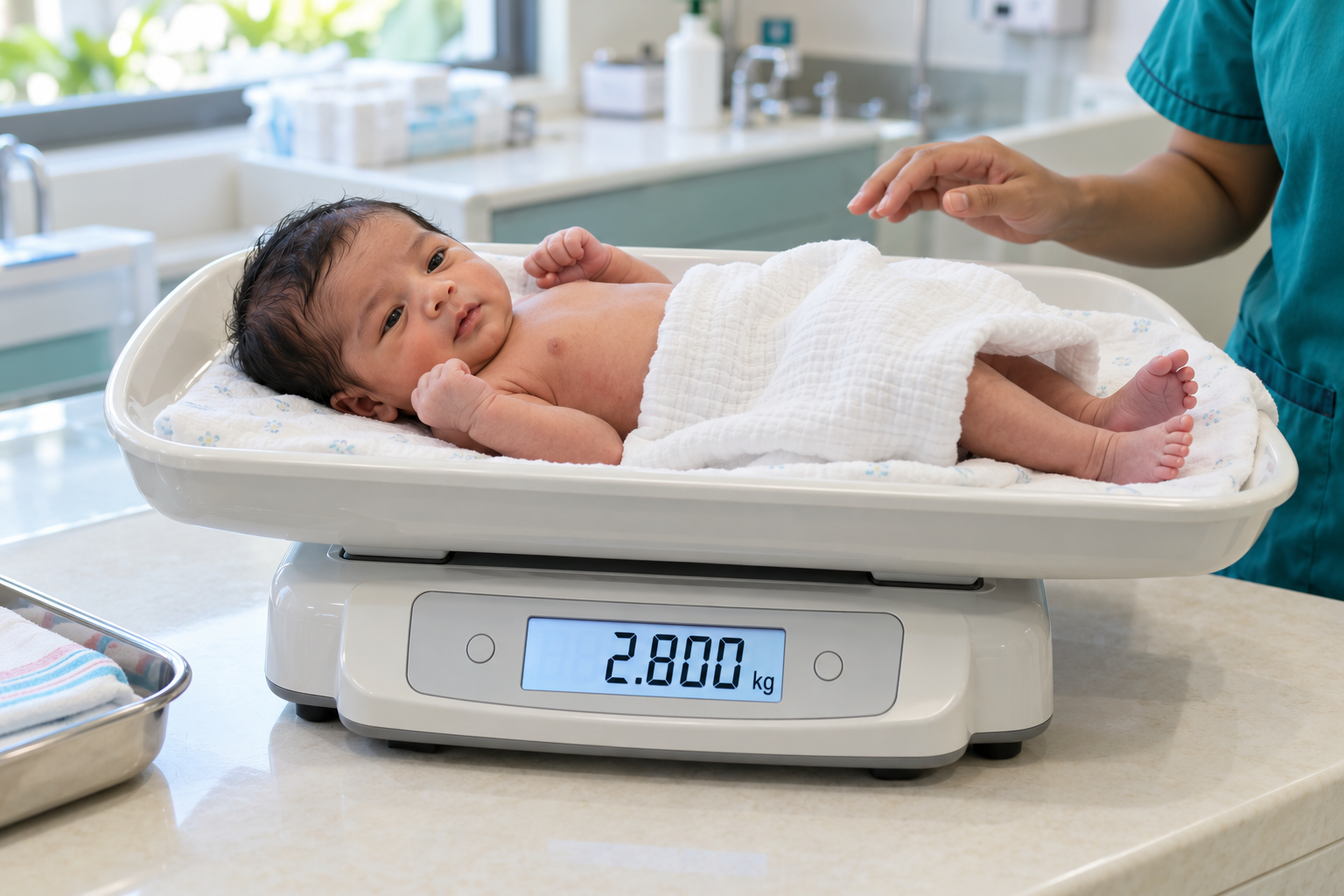
When comparing two weights, first check when each was recorded. A scan taken before delivery and a weight measured after birth describe different moments. The longer the interval, the more opportunity there is for growth between the two measurements.
Keep the scan date, gestational age and estimated weight together when discussing the difference with your doctor. A difference of a few hundred grams cannot be interpreted fairly without that context.
Does a difference mean something is wrong?
A difference alone does not diagnose a problem. Equally, a reassuring weight estimate does not assess every aspect of your baby’s health. Your doctor considers gestational age, the growth percentile, changes over time and other scan findings before deciding whether further assessment is needed.
If your doctor mentions a baby measuring smaller or larger than expected, follow their advice about review appointments and any further scans. Avoid interpreting a single number without the rest of your report.
Watch the doctor explain
Watch this Nisarga Diagnostics Instagram reel to understand why your baby’s scan weight and birth weight may differ.
How to discuss your growth scan report
Bring your previous scan reports and your doctor’s prescription. Ask whether the estimated weight is appropriate for your stage of pregnancy, whether the growth pattern needs monitoring, and when you should return. Your doctor will choose the timing of any follow-up scan based on your circumstances.
Understanding pregnancy dates is also helpful. Read how pregnancy weeks are calculated and our guide to NT and anomaly scan preparation for information about other stages of pregnancy care.

Read the whole report, not just the grams
Look for the scan date, gestational age, estimated fetal weight and any comments about growth or follow-up. If a percentile is listed, ask your gynaecologist how it relates to your baby’s stage of pregnancy and previous results.
Write down your questions before the consultation. Useful questions include: “Is the growth appropriate for my pregnancy weeks?”, “How does this compare with the previous scan?” and “When should I return for review?”
Frequently asked questions
Is baby weight in growth scan an exact measurement?
No. It is a calculated estimate from ultrasound measurements. Birth weight is measured directly after delivery.
Will my baby definitely weigh within the ± range?
No. The range expresses uncertainty; it is not a guarantee. The interval before delivery also matters.
Can the scan estimate be higher or lower than birth weight?
Yes. An ultrasound estimate may be above or below the measured birth weight. Your doctor can explain the difference in the context of the scan date and pregnancy.
Should I repeat a scan immediately if I am worried about the weight?
Discuss the report with your gynaecologist first. They will decide whether another scan is needed and when it would be useful.
What else should I pay attention to?
Continue your antenatal visits and follow your maternity team’s advice. Read our guide on how to track baby movements. If movements decrease or change from your baby’s usual pattern, contact your maternity team promptly rather than waiting for the next scheduled scan.
A practical way to understand your baby’s weight
Think of the estimated fetal weight as one piece of information about your pregnancy. Note the scan date, understand any stated margin of variation, and discuss the result alongside your previous reports. Avoid comparing your baby’s weight with another pregnancy, because the pregnancy weeks and individual circumstances may differ.
The most useful next step is to follow the review plan advised by your gynaecologist. Keep your reports together so that changes can be assessed over time, and ask for an explanation whenever a term or number is unclear.
This article provides general educational information and does not replace individual advice from your gynaecologist.
Medical reference: ISUOG practice guidelines on ultrasound assessment of fetal biometry and growth.

Founder of Nisarga Diagnostics, is a renowned fetal ultrasound specialist with over 20 years of expertise. An alumnus of Government Medical Colleges in Mysore and Bangalore, he also holds a D.N.B. from the National Board of Examinations, Delhi, and certification from the Fetal Medicine Foundation, London. A former Professor and HOD, he has trained countless PG students and junior radiologists, shaping the future of fetal imaging in India.