


Married for 2 Weeks but 5 Weeks Pregnant? Here’s Why
You have been married for only two weeks, but the ultrasound report says the pregnancy is five weeks. How can that be?
This situation can surprise newly married couples and may cause unnecessary worry or misunderstanding. However, the explanation is simple: pregnancy is not calculated from the date of marriage, intercourse or fertilisation.
Doctors follow a standard medical method in which pregnancy duration is calculated from the first day of the woman’s last menstrual period.
Understanding how pregnancy weeks are calculated can help couples read an early pregnancy scan report calmly and correctly.
Watch our video on: Married for 2 Weeks but 5 Weeks Pregnant? Here’s Why
How Pregnancy Weeks Are Calculated?
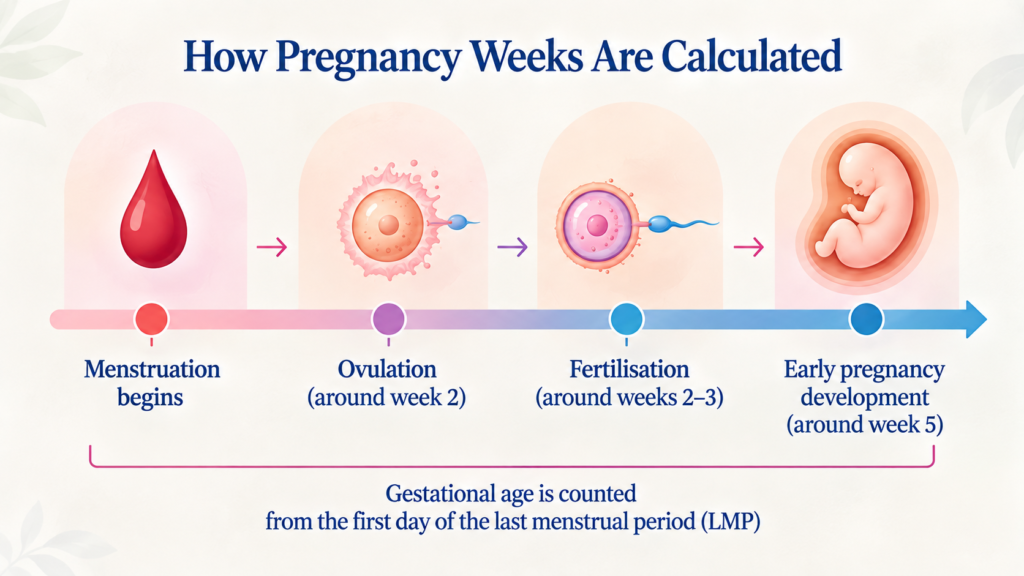
Pregnancy duration is usually recorded as gestational age. It is counted from the first day of the woman’s last menstrual period, commonly known as the LMP.
This means the medical pregnancy count begins approximately two weeks before ovulation and fertilisation in a woman with a typical 28-day menstrual cycle.
Ovulation generally occurs around the middle of the menstrual cycle. If the egg is fertilised during this period, the actual age of the developing embryo may be approximately two weeks less than the gestational age mentioned in the pregnancy report.
Therefore, when an embryo has been developing for approximately two to three weeks after fertilisation, the pregnancy may already be described medically as four to five weeks.

A Simple Pregnancy Calculation Example
Let us assume that the first day of a woman’s last menstrual period was five weeks ago.
Week 1: The menstrual period begins.
Around week 2: Ovulation may occur.
Around weeks 2 to 3: Fertilisation may occur if the egg and sperm meet.
Around week 5: The medical gestational age is five weeks, although the time since fertilisation may be closer to three weeks.
Therefore, if a couple got married two weeks ago and the scan report mentions five weeks of pregnancy, it does not necessarily mean that fertilisation happened five weeks earlier.
The report is showing gestational age calculated from the last menstrual period.
Gestational Age vs Fetal Age
Gestational age and fetal age describe two different pregnancy timelines.
Gestational age is calculated from the first day of the last menstrual period. This is the pregnancy duration generally mentioned in medical records and ultrasound reports.
Fetal or embryonic age refers approximately to the time since fertilisation. In a typical menstrual cycle, fetal age may be approximately two weeks less than gestational age.
Doctors usually use gestational age because the exact date of ovulation or fertilisation is often difficult to determine. However, many women can remember the first day of their last menstrual period.
Why Pregnancy Dates May Not Always Match Exactly
The LMP calculation generally assumes a regular menstrual cycle, with ovulation occurring around the middle of the cycle.
However, every woman’s menstrual cycle is different. Pregnancy dating may vary when:
• The menstrual cycles are irregular
• The cycle is shorter or longer than 28 days
• Ovulation happened earlier or later than expected
• The woman is unsure about her last menstrual period
• There was irregular bleeding that was mistaken for a period
• The woman recently stopped hormonal contraception
• The woman is breastfeeding
• The pregnancy occurred through fertility treatment
Because of these factors, the number of pregnancy weeks calculated from the LMP and the number estimated during an ultrasound may not always be exactly the same.
How an Early Pregnancy Scan Helps
An early pregnancy ultrasound helps the doctor evaluate the pregnancy and determine whether its development is appropriate for the estimated gestational age.
The scan may help assess:
• Whether the pregnancy is located inside the uterus
• The pregnancy structures visible at that stage
• The number of pregnancies
• Cardiac activity when it is expected to be visible
• The estimated gestational age
• The estimated due date
When the scan is performed very early, it may be too soon to see all the expected pregnancy structures or cardiac activity. This does not always indicate a problem.
Depending on the scan findings, menstrual history and symptoms, the doctor may recommend a repeat scan after an appropriate interval.
A dating scan performed during the first trimester may help estimate the pregnancy duration more accurately, especially when the LMP is uncertain or the menstrual cycles are irregular.
Can an Ultrasound Reveal the Exact Date of Conception?
An ultrasound can estimate the gestational age of the pregnancy, but it usually cannot identify the exact date of conception.
Ovulation does not always occur on the same day in every menstrual cycle. Sperm may also survive inside the female reproductive tract for several days.
Therefore, there can be a natural difference of a few days between the estimated and actual date of fertilisation.
Ultrasound findings should always be interpreted along with the woman’s menstrual history, cycle length, symptoms and previous medical reports.
When Should You Consult a Doctor Urgently?
A difference in pregnancy dates is often caused by the standard LMP calculation or normal variations in ovulation.
However, women should seek prompt medical attention if early pregnancy is accompanied by:
• Heavy vaginal bleeding
• Severe lower abdominal pain
• Pain mainly on one side of the abdomen
• Shoulder-tip pain
• Dizziness or fainting
• Severe weakness
• Any other symptoms that the treating doctor has advised not to ignore
These symptoms require proper medical evaluation and should not be explained only as a difference in pregnancy dates.

There Is No Need to Panic or Misunderstand
If a couple has been married for two weeks and the scan says five weeks pregnant, the dates are not automatically contradictory.
The pregnancy calculation includes approximately two weeks before fertilisation because gestational age is counted from the first day of the last menstrual period.
The number of weeks mentioned in the scan report should never be used alone to make personal assumptions or create misunderstandings between partners.
The woman’s menstrual history, cycle length and ultrasound findings should be interpreted together by a qualified doctor or radiologist.
Early Pregnancy Scan at Nisarga Diagnostics, SanjaynagarAt Nisarga Diagnostics, Sanjaynagar, Bengaluru, pregnancy scans are performed with careful assessment and clear communication.
If you are unsure about your pregnancy dates or have been advised to undergo an early pregnancy or dating scan, consult your doctor and schedule the appropriate scan as recommended.
When visiting for the scan, bring your previous medical reports and note the first day of your last menstrual period, if known. This information can help the doctor or radiologist assess the pregnancy dates more accurately.
To book an early pregnancy scan in Bengaluru, contact Nisarga Diagnostics, Sanjaynagar.
Frequently Asked Questions
Can I be five weeks pregnant if I got married two weeks ago?
Yes. Pregnancy weeks are usually counted from the first day of the last menstrual period, not from the wedding date or the date of intercourse. In a typical menstrual cycle, the medical pregnancy count starts approximately two weeks before fertilisation.
Why is pregnancy counted before fertilisation?
No. Five weeks pregnant usually means five weeks of gestational age calculated from the LMP. The time since fertilisation may be approximately three weeks, although the exact timing of ovulation can vary.
Which date is used to calculate pregnancy?
For most naturally conceived pregnancies, doctors initially calculate pregnancy from the first day of the last menstrual period. Ultrasound findings may help confirm or revise the pregnancy dates when the cycles are irregular or the LMP is uncertain.
Can an early ultrasound determine the exact date of conception?
No. An ultrasound can estimate gestational age, but it usually cannot determine the exact day of fertilisation. A normal margin of variation is possible.
What if my LMP date and ultrasound dates are different?
A small difference can happen because menstrual cycle length and ovulation timing vary. Your doctor will determine the most appropriate pregnancy date based on the ultrasound findings, menstrual history and stage of pregnancy.
Why is pregnancy counted before fertilisation?
The exact day of fertilisation is often unknown. The first day of the last menstrual period is generally easier to identify, so it is used as the standard starting point for calculating pregnancy duration.
Conclusion
Understanding how pregnancy weeks are calculated can prevent unnecessary confusion among newly married couples.
A five-week pregnancy report does not mean that conception happened five weeks earlier. It usually means that five weeks have passed since the first day of the woman’s last menstrual period.
If your pregnancy dates appear confusing, speak with your doctor and undergo the recommended ultrasound examination. Proper medical guidance can help clarify the dates and assess the development of the pregnancy.

Founder of Nisarga Diagnostics, is a renowned fetal ultrasound specialist with over 20 years of expertise. An alumnus of Government Medical Colleges in Mysore and Bangalore, he also holds a D.N.B. from the National Board of Examinations, Delhi, and certification from the Fetal Medicine Foundation, London. A former Professor and HOD, he has trained countless PG students and junior radiologists, shaping the future of fetal imaging in India.