

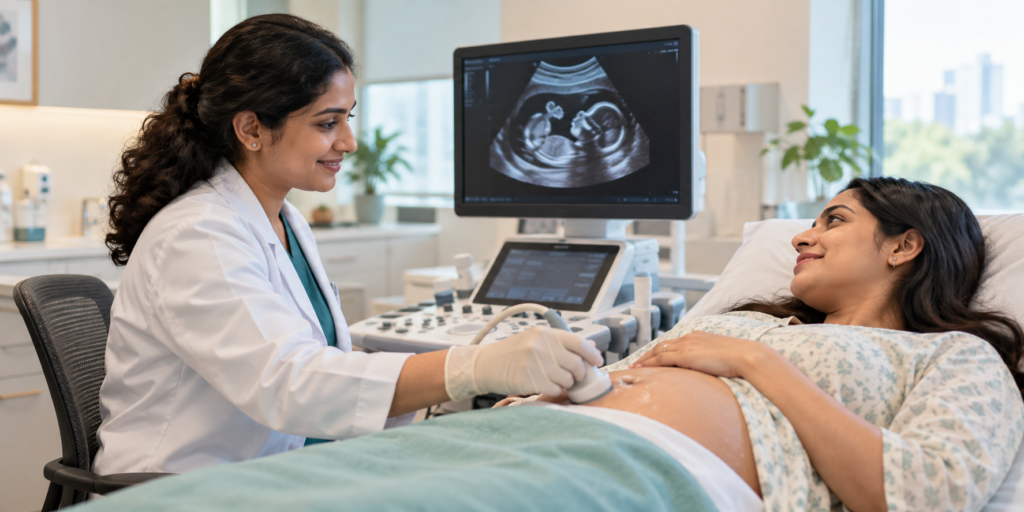
An NT scan or anomaly scan is an important pregnancy ultrasound, and arriving prepared can make the visit smoother. The two scans are performed at different stages of pregnancy and may take longer than a routine scan because the radiologist needs to obtain specific views and measurements.
Quick preparation guide
- Book the NT scan within the recommended first-trimester window and the anomaly scan at the stage advised by your doctor.
- Carry your original doctor’s prescription, a valid ID proof, address proof, and previous scan reports or relevant medical records.
- Keep enough time for your appointment. Do not plan another commitment immediately afterwards.
- Usually, you do not need to fast or arrive with a full bladder for these scans. Follow any specific instructions given by the centre.
This guide to NT and anomaly scan preparation explains the timing, documents, and common mistakes to avoid. Your doctor’s advice and the instructions provided for your appointment should always take priority.
1. Do not miss the recommended scan window
The NT scan is generally scheduled between 11 weeks and 13 weeks 6 days of pregnancy. The recommended window matters because the measurements used for this screening are interpreted in relation to the baby’s size and gestational age. Please confirm the exact date with your obstetrician or fetal medicine specialist.
The detailed anomaly scan, also called the anatomy or TIFFA scan, is commonly performed around 18 to 22 weeks, as advised by your doctor. If you are unsure of your pregnancy dates or have missed a suggested appointment, contact your doctor or diagnostic centre promptly instead of choosing a new date on your own.

Timing matters
Book within the window your doctor recommends
Do not delay booking until the last few days of the advised period. If the appointment date is close to the end of your recommended window, call the centre to check availability and ask your doctor for guidance.
2. Bring the right documents and previous reports
Having your records ready helps the radiologist understand the reason for the scan and compare relevant findings. Please bring:
- The original doctor’s prescription
- A valid ID proof
- Address proof
- Previous pregnancy scan reports, blood test results, and relevant medical records
- Details of your pregnancy history, if applicable
If you have a report from another centre, carry the full report and images or films if they were provided. Do not rely only on a short message or a photograph of one page.
Bring your records
Keep prescriptions and reports together
Place your prescription, ID, address proof, earlier scan reports, and other relevant records in one folder. Tell the radiologist about your pregnancy history, current medicines, and any concerns you would like to discuss.

3. Allow enough time for the scan
NT and anomaly scans require careful assessment. The radiologist may need to capture several measurements and views, so the appointment can take longer than expected. The baby’s position can also affect how easily some views are obtained. You may be asked to change position, wait briefly, or take a short walk before the scan continues.
Arrive on time and keep your schedule flexible. If a particular view cannot be obtained during the visit, the radiologist will explain what is needed next. Allowing extra time can help you avoid feeling rushed.

Plan your visit
Keep time before and after the appointment
Please arrive at your scheduled time, but avoid planning a tight onward schedule. A little flexibility is helpful if the radiologist needs additional views or a short pause.
4. Do not fast or force a full bladder unless instructed
For an NT scan or anomaly scan, fasting is generally not required, and a full bladder is usually not needed. You can eat and drink normally unless your doctor or the diagnostic centre has given you a different instruction for your specific appointment. Do not deliberately hold urine if you are uncomfortable. If the scan is planned using a particular approach or there is an individual medical reason, the centre will advise you.
Continue prescribed medicines as directed by your doctor. Do not stop, skip, or change any medication just for the scan unless your doctor tells you to.
5. Share your medical and pregnancy history
Before the scan, tell the radiologist about any previous pregnancy complications, relevant medical conditions, current medicines, allergies, or concerns. Mention the date of your last menstrual period or your expected due date if known, and share previous reports. This context can help the team interpret the examination appropriately.
6. Remember that these scans have different purposes
An NT scan is part of first-trimester screening. It estimates the chance of certain conditions; it is not, by itself, a diagnostic test. The anomaly scan is a detailed ultrasound examination of the baby’s anatomy. One scan does not replace the other, and a reassuring scan cannot rule out every possible condition. Your doctor can explain the findings and whether any additional tests are appropriate.
Read our related guides: what an anomaly scan checks, the morphology scan during pregnancy, and early pregnancy scan mistakes to avoid.
Watch: NT and anomaly scan preparation
Watch this short video from Nisarga Diagnostics for a quick reminder before your appointment:
Frequently asked questions
Do I need to come on an empty stomach for an NT or anomaly scan?
Usually, no. Fasting is generally not required for these pregnancy scans unless the centre or your doctor has given you specific instructions.
Should my bladder be full?
A full bladder is usually not needed for an NT or anomaly scan. Follow the instructions given for your appointment, and do not hold urine if you are uncomfortable.
What should I bring to the appointment?
Bring the original prescription, valid ID proof, address proof, previous scan reports, and relevant medical records.
How much time should I keep free?
Keep your schedule flexible because these scans need careful views and measurements. The time can vary from one appointment to another.
What does an NT scan assess?
An NT scan measures the fluid at the back of the baby’s neck as part of first-trimester screening. The measurement helps estimate the chance of certain conditions; your doctor interprets it with the pregnancy dates and any other recommended screening results.
Is a blood test always done with an NT scan?
Not in every screening plan. Some first-trimester screening pathways combine the NT measurement with a maternal blood test. Ask your obstetrician which tests are recommended for you and when they should be done.
What does the anomaly scan check?
The anomaly scan provides a detailed ultrasound assessment of the baby’s anatomy. The radiologist checks the structures that can be assessed at this stage and may also review growth and the placenta, depending on the request and scan protocol.
Can an anomaly scan detect every condition?
No. Ultrasound can identify many structural concerns, but it cannot detect every condition. A normal scan is reassuring, but it cannot guarantee that every possible health condition has been ruled out.
What if the baby’s position makes some views difficult?
The radiologist may ask you to change position, wait briefly, or take a short walk. If all the required views cannot be obtained, the team will explain whether another appointment or other follow-up is needed. Difficulty getting a view does not by itself mean that a problem has been found.
What should I do if I have missed the recommended scan window?
Contact your obstetrician or diagnostic centre as soon as possible. The next steps depend on how far along the pregnancy is and the reason for the scan, so your doctor can advise which assessment or screening options are appropriate.
Does a recommendation for follow-up mean something is wrong?
Not necessarily. Follow-up may be suggested when a view was unclear, an additional assessment is needed, or a finding requires closer review. Discuss the report with your obstetrician, who can explain what it means and whether further tests are needed.
Plan your pregnancy scan
For appointment instructions or scan-related questions, contact Nisarga Diagnostics, Sanjaynagar, Bengaluru. Please follow the advice of your obstetrician and the diagnostic team for your individual care.
Educational information only. Scan timing, preparation, and follow-up should be confirmed with your treating doctor and diagnostic centre.

Founder of Nisarga Diagnostics, is a renowned fetal ultrasound specialist with over 20 years of expertise. An alumnus of Government Medical Colleges in Mysore and Bangalore, he also holds a D.N.B. from the National Board of Examinations, Delhi, and certification from the Fetal Medicine Foundation, London. A former Professor and HOD, he has trained countless PG students and junior radiologists, shaping the future of fetal imaging in India.