


Do Twins Have the Same Heartbeat? Understanding Twin Heart Rates
Seeing two heartbeats during a twin-pregnancy ultrasound is a memorable and reassuring moment for parents. However, when the ultrasound report shows a different heart rate for each baby, it can naturally lead to concern.
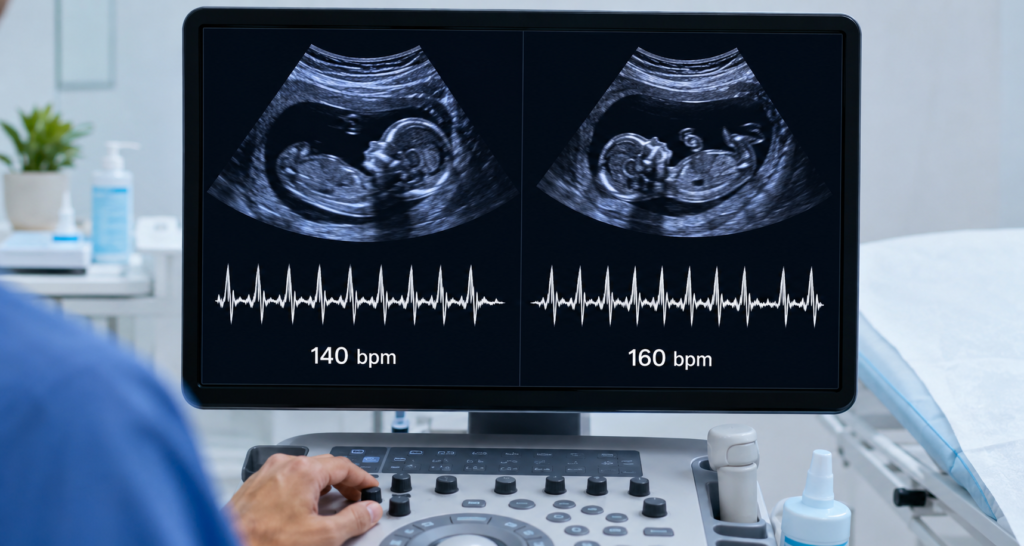
One twin may have a heart rate of 140 beats per minute, while the other may have a heart rate of 160 beats per minute. Does this difference indicate a problem?
In many cases, it does not. Twin babies do not need to have exactly the same heartbeat. Each baby is an individual, and the radiologist assesses each twin separately during the ultrasound scan.
Watch our video on: Do Twins Have the Same Heartbeat?
Do Twins Have the Same Heartbeat?
No, twin babies do not necessarily have the same heart rate.
Although both babies are developing inside the same uterus, each baby has an individual heart, circulatory system, pattern of movement and level of activity. Their heart rates can therefore differ when measured during an ultrasound.
For example:
- Twin 1 may have a heart rate of 140 beats per minute.
- Twin 2 may have a heart rate of 160 beats per minute.
A difference such as this does not automatically mean that one baby is healthy and the other is not. The significance of the readings depends on several factors, including the stage of pregnancy, the babies’ movements, the rhythm of each heartbeat and the other ultrasound findings
Why Can Twin Heart Rates Be Different?
A fetal heart rate is not a fixed number. It may change naturally during the scan.
Several factors can contribute to a difference between the heart rates of twins.
1. Different activity levels
One baby may be moving actively while the other is resting. The more active baby may temporarily show a higher heart rate, while the calmer baby may have a comparatively lower reading.
The babies’ positions and movements can also change throughout the examination. Therefore, a heart rate recorded at one moment may be slightly different from a measurement taken a few minutes later.
2. Each baby has an independent heartbeat
Twins share the uterus, but each baby has an individual heart. Even identical twins are separate babies with their own heartbeat patterns.
Their heart rates are not expected to rise, fall or remain at the same number simultaneously.
3. The heart rates may be measured at different moments
During an ultrasound, the radiologist usually examines one baby and then the other. Because the measurements are not always recorded at precisely the same second, one baby may be active during measurement while the other may be resting.
This can produce different readings on the ultrasound report.
4. Gestational age influences fetal heart rate
The expected fetal heart rate changes as pregnancy progresses. It rises during early pregnancy and gradually changes as the baby develops.
For this reason, a heart-rate measurement must always be interpreted according to the gestational age rather than treated as an isolated number.
Are Heart Rates of 140 and 160 Normal for Twins?
A fetal heart rate is commonly expected to fall within an approximate range of 110 to 160 beats per minute during much of pregnancy. However, the expected range and interpretation can vary depending on gestational age, the duration of the measurement and the clinical situation.
Therefore, readings of 140 and 160 beats per minute may both be reassuring in the appropriate context. The difference alone does not necessarily indicate a complication.
A single number should not be used to judge the health of either baby. Your radiologist will also look at:
- Whether the heartbeat has a regular rhythm
- Whether the rate remains unusually high or low
- The movements of each baby
- Each baby’s growth and anatomy
- Amniotic-fluid levels
- Placental function
- Umbilical-cord blood flow, when assessed
- Other findings from the ultrasound examination
How Are Twin Heartbeats Checked During an Ultrasound?
During the scan, the radiologist identifies each baby separately, often documenting them as Twin 1 and Twin 2 or Twin A and Twin B.
The heartbeat of each baby is then measured individually. The radiologist carefully confirms that the two readings are obtained from the two separate babies, especially when they are positioned close together.
Ultrasound is particularly useful in a twin pregnancy because it can assess the separate heartbeat, growth, movement, anatomy and surroundings of each baby.
Your report may include an individual fetal heart-rate measurement for each twin. It is normal for these numbers not to match exactly.
Does a Difference in Heart Rate Mean One Twin Is Weaker?
Not necessarily.
A lower heart rate at a particular moment does not automatically mean that one twin is weaker. Similarly, a higher reading does not necessarily mean that the other baby is stronger or healthier.
A baby who is resting may have a lower heart rate than a baby who is actively moving. The radiologist interprets the heartbeat alongside the baby’s growth, movements, blood flow, amniotic fluid and other scan findings.
The health of twin babies should never be compared using only one pair of heart-rate measurements.

When Does a Twin Heartbeat Require Further Assessment?
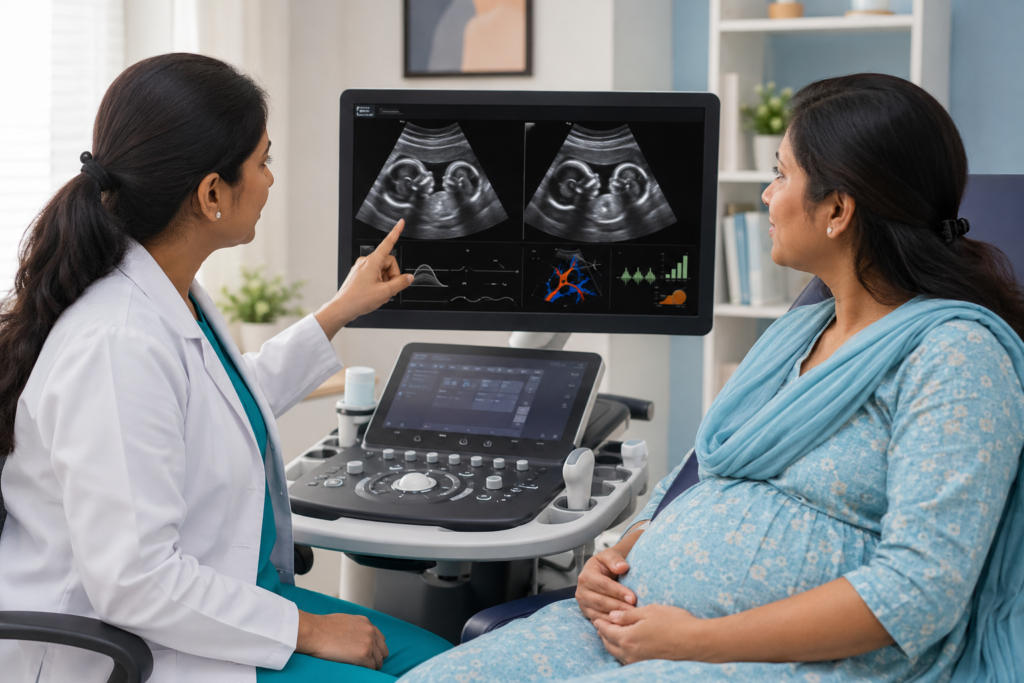
Different heart rates between twins are often a normal finding. However, the radiologist may recommend further evaluation if:
- One baby’s heart rate remains unusually high or low
- An irregular heartbeat is detected
- The heart-rate difference is persistent and accompanied by other abnormal findings
- One baby is growing more slowly than expected
- There is a significant difference in the babies’ growth
- Abnormal Doppler blood-flow findings are present
- There is an unusual difference in amniotic-fluid levels
- A structural concern involving the heart is suspected
Depending on the finding, the doctor may advise a repeat ultrasound, fetal Doppler study, growth scan or fetal echocardiography.
This does not always mean that a serious problem is present. Additional testing helps the medical team understand the finding more clearly and monitor both babies appropriately.
Why Regular Ultrasound Monitoring Is Important in Twin Pregnancy
Twin pregnancies generally require closer monitoring than pregnancies with one baby. The frequency of scans depends partly on whether the babies have separate placentas or share a placenta.
Ultrasound examinations may be used to monitor:
- The growth of each baby
- The heartbeat and movements of each twin
- The amount of amniotic fluid around each baby
- Placental location and function
- Blood flow through the umbilical cord and fetal vessels
- Differences in growth between the twins
- Twin-specific complications
Regular monitoring allows the radiologist and obstetrician to evaluate each baby individually while also observing how the pregnancy is progressing overall.
Should Parents Be Worried If the Heart Rates Do Not Match?
In most situations, parents should not worry simply because the two numbers are different.
Twin heart rates do not need to match. What matters is whether each baby’s heartbeat is appropriate for the stage of pregnancy and whether the remaining ultrasound findings are reassuring.
Instead of comparing the two numbers directly, discuss the following questions with your radiologist:
- Is each baby’s heart rate appropriate for the gestational age?
- Are both heart rhythms regular?
- Are both babies moving appropriately?
- Is their growth progressing as expected?
- Are the Doppler and amniotic-fluid findings reassuring?
- When should the next twin-pregnancy scan be performed?
This provides a more complete understanding than focusing on the difference between two individual heart-rate readings.
Frequently Asked Questions
Do identical twins have the same heartbeat?
No. Identical twins may share the same genetic origin, but each baby has an individual heart and heartbeat. Their heart rates do not need to be exactly the same.
Can one twin’s heartbeat be faster than the other’s?
Yes. One twin may temporarily have a faster heartbeat, particularly if that baby is more active at the time of the ultrasound.
Is a 20-beat difference between twin heart rates dangerous?
Not necessarily. For example, readings of 140 and 160 beats per minute may both be acceptable depending on the gestational age and the complete ultrasound assessment. The difference should be interpreted by the radiologist rather than considered independently.
Can the babies’ positions affect heartbeat measurement?
The babies’ positions can make it more challenging to obtain separate readings, especially when they are close together. Ultrasound helps the radiologist identify and measure the heartbeat of each baby accurately.
What happens if one twin has an irregular heartbeat?
The radiologist may observe the heartbeat for a longer period or recommend a repeat scan or fetal echocardiography. The next step depends on the type and persistence of the irregularity and whether other findings are present.
How often should a twin pregnancy be scanned?
The scan schedule depends on the type of twin pregnancy, particularly whether the babies have separate placentas or share one. Your obstetrician or fetal-medicine specialist will recommend an appropriate monitoring schedule.
Conclusion
Twins do not need to have the same heartbeat. Even though they are developing in the same uterus, each baby has an individual heart rate that can change with movement, rest, gestational age and the timing of measurement.
A difference such as 140 beats per minute in one twin and 160 beats per minute in the other does not automatically indicate a problem. What matters is the complete assessment of each baby’s heartbeat, rhythm, growth, movements, blood flow and overall well-being.
If you have questions about the heart-rate readings in your twin-pregnancy ultrasound report, speak with your radiologist or obstetrician for an interpretation based on your stage of pregnancy and complete scan findings.
For twin-pregnancy ultrasound monitoring and fetal assessment, contact:
Nisarga Diagnostics
Sanjaynagar, Bangalore

Founder of Nisarga Diagnostics, is a renowned fetal ultrasound specialist with over 20 years of expertise. An alumnus of Government Medical Colleges in Mysore and Bangalore, he also holds a D.N.B. from the National Board of Examinations, Delhi, and certification from the Fetal Medicine Foundation, London. A former Professor and HOD, he has trained countless PG students and junior radiologists, shaping the future of fetal imaging in India.