

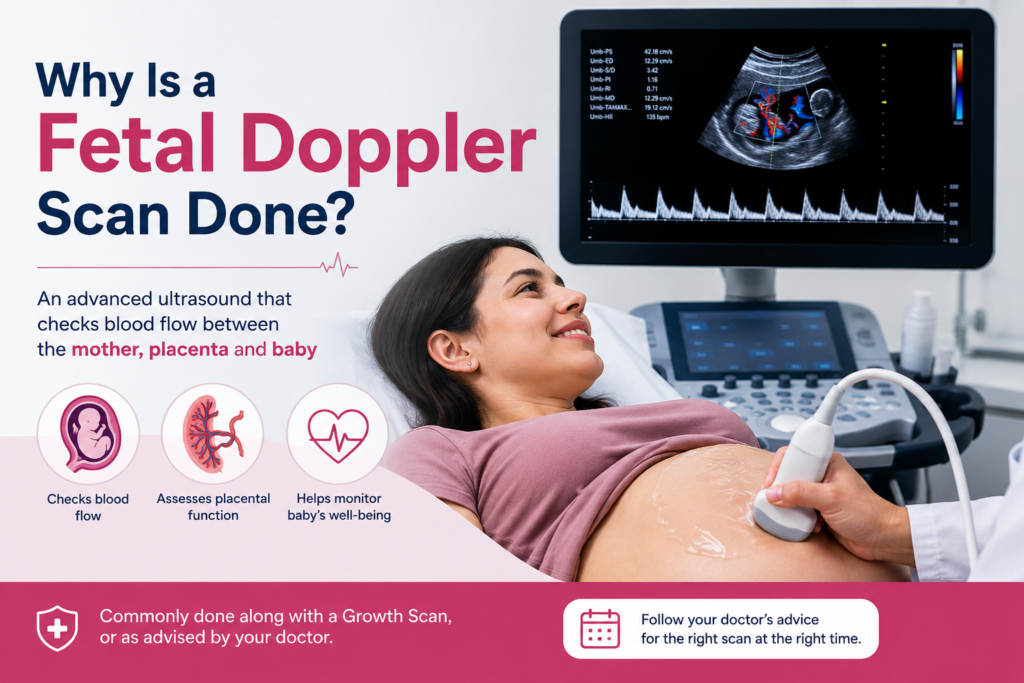
Why Is a Fetal Doppler Scan Done During Pregnancy?
Pregnancy involves several ultrasound examinations that help doctors monitor the development and well-being of the baby. While routine ultrasound scans provide important information about the baby’s growth and anatomy, sometimes doctors need additional information about blood circulation between the mother, placenta, and baby.
This is where a Fetal Doppler Scan can be useful.
A Fetal Doppler uses Doppler ultrasound technology to assess blood flow through selected blood vessels. It is commonly performed along with a Growth Scan, although your doctor may recommend it separately depending on the pregnancy.
Watch our video on: Fetal Doppler Scan during pregnancy
What Is a Fetal Doppler Scan?
A Fetal Doppler Scan is an ultrasound examination that evaluates the movement of blood through important blood vessels associated with the pregnancy.
A regular ultrasound primarily provides information about the baby’s anatomy, measurements, movements, placenta, and other pregnancy-related findings.
Doppler ultrasound adds another layer of information by helping the radiologist assess blood-flow patterns.
Why Is a Fetal Doppler Scan Done?
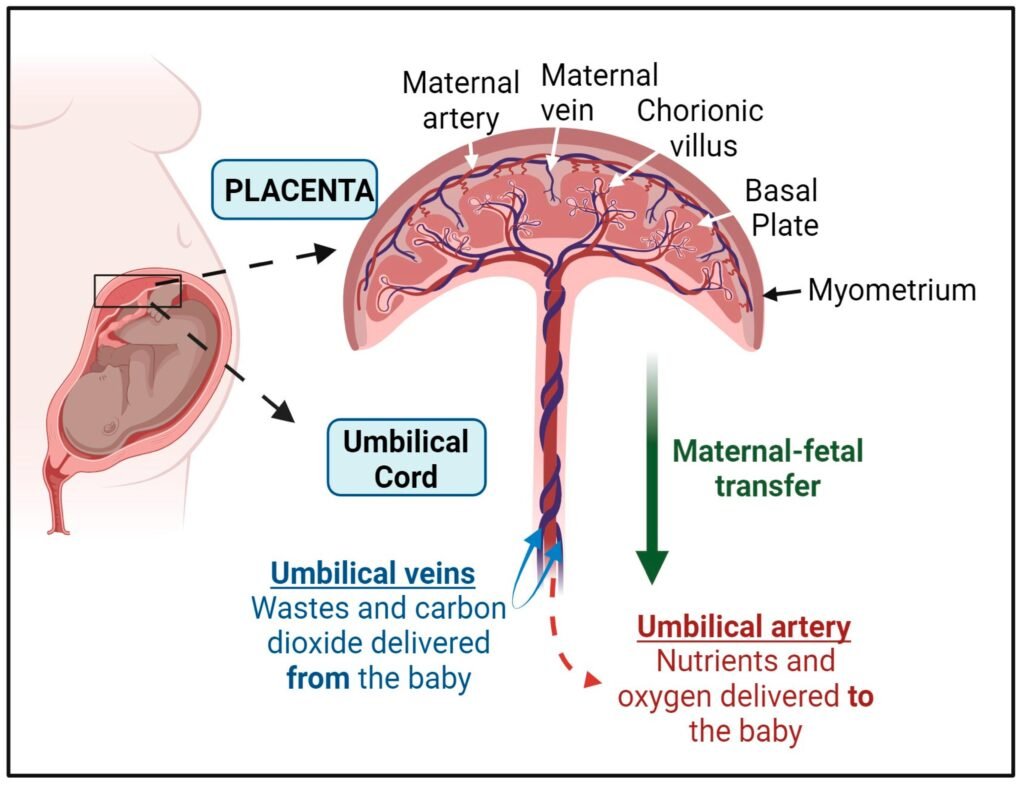
The main purpose of a Fetal Doppler Scan is to help assess how blood is circulating between the mother, placenta, and developing baby.
The placenta plays an essential role in delivering oxygen and nutrients to the baby. Doppler measurements can provide doctors with additional information about this circulation.
The results are interpreted together with other information such as:
- Baby’s growth measurements
- Gestational age
- Placental findings
- Amniotic fluid
- Previous ultrasound findings
- Mother’s clinical history
A Doppler scan should therefore not be interpreted independently from the rest of the pregnancy assessment.
What Blood Vessels May Be Checked?
Depending on the clinical requirement, the radiologist may assess blood flow through different vessels.
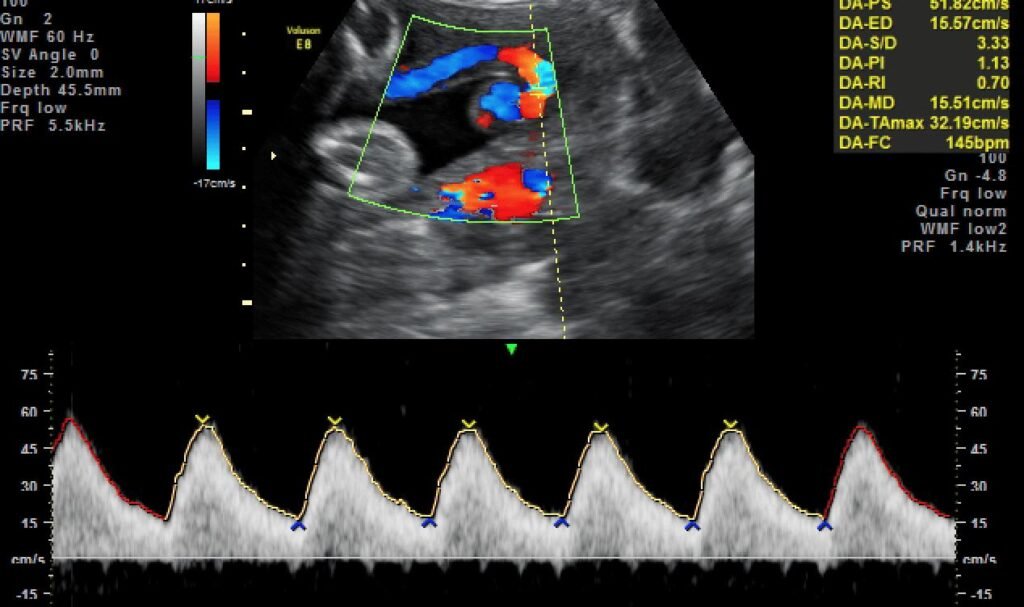
One commonly evaluated vessel is the umbilical artery, which provides information related to circulation between the baby and placenta.
In certain situations, other vessels may also be assessed depending on the pregnancy and the doctor’s recommendation.
The exact Doppler measurements required can vary from one pregnancy to another.
Is a Fetal Doppler the Same as a Growth Scan?
No. They provide different but complementary information.
A Growth Scan is primarily used to assess the baby’s growth and development. Measurements may be taken of different parts of the baby’s body to estimate fetal growth.
A Fetal Doppler, meanwhile, focuses on blood-flow patterns in selected vessels.
This is why doctors frequently recommend a Growth Scan with Doppler rather than performing the examinations completely independently.
When May a Fetal Doppler Scan Be Recommended?
A Doppler examination may be recommended when the treating doctor wants additional information about fetal or placental circulation.
The decision depends on the individual pregnancy, medical history, previous ultrasound findings, and the treating doctor’s assessment.
Not every pregnant woman requires the same number or type of Doppler examinations.
Always follow the scan schedule recommended by your obstetrician or treating doctor.
Why Are Previous Pregnancy Scan Reports Important?
One important preparation for your Fetal Doppler appointment is something many patients overlook:
Bring your previous pregnancy scan reports.
Previous reports allow the radiologist to compare current findings with earlier examinations.
For example, the pregnancy dating established during an earlier scan can help provide an appropriate reference when assessing the baby’s growth later in pregnancy.
Without previous reports, important information regarding the pregnancy timeline and earlier findings may not be immediately available.
Therefore, even if you decide to visit the diagnostic centre while you are already nearby, try to carry your previous pregnancy records rather than undergoing the examination without them.
How to Prepare for a Fetal Doppler Scan
Preparation for a Fetal Doppler is generally straightforward.
Before visiting the diagnostic centre, remember to bring:
Doctor’s prescription:
Carry the original prescription recommending the examination.
ID and address proof:
Keep the necessary identification documents with you.
Previous pregnancy scan reports:
Bring your Dating Scan, NT Scan, Anomaly Scan, Growth Scan, and other relevant pregnancy reports whenever available.
Is fasting required?
Usually, fasting is not required for a Fetal Doppler Scan.
Do I need a full bladder?
A full urinary bladder is usually not required for this examination.
If your doctor or diagnostic centre has provided specific instructions for your particular examination, follow those instructions.
What Happens During the Scan?
The examination is performed using an ultrasound machine.
You will usually lie comfortably while ultrasound gel is applied over the abdomen. The radiologist uses the ultrasound probe to examine the baby and obtain the required Doppler measurements.
Doppler technology can display information related to blood flow, which is then interpreted by the radiologist in the context of the pregnancy.
The procedure is non-invasive.
Why Is the Fetal Doppler Often Combined With a Growth Scan?
Fetal growth and blood circulation can provide complementary information.
The Growth Scan tells doctors about parameters related to the baby’s size and growth, while Doppler assessment provides information about blood-flow patterns.
Looking at these findings together can provide a more complete assessment than relying on either measurement alone when Doppler evaluation is clinically indicated.
Can You Get a Fetal Doppler Without a Doctor's Advice?
Pregnancy ultrasound examinations should be performed according to appropriate medical advice and applicable regulations.
Your treating doctor understands your pregnancy history and can determine which scans are required and when they should be performed.
Avoid scheduling additional pregnancy scans simply because another pregnant woman underwent the same examination. Every pregnancy is different.
Fetal Doppler Scan at Nisarga Diagnostics
At Nisarga Diagnostics, Sanjaynagar, Bangalore, pregnancy ultrasound examinations are performed based on the treating doctor’s prescription and clinical requirements.
If you have been advised to undergo a Fetal Doppler or Growth Scan with Doppler, remember to carry your doctor’s prescription, identification documents, and all previous pregnancy scan reports for appropriate comparison.
Frequently Asked Questions
Why is a Fetal Doppler Scan done?
A Fetal Doppler Scan is used to assess blood-flow patterns in selected blood vessels associated with the mother, placenta, and baby. It provides additional information that can complement routine ultrasound and fetal growth assessment.
Is Doppler included in every Growth Scan?
Not necessarily. Your doctor will determine whether Doppler assessment is required based on the pregnancy and clinical findings.
Do I need to fast before a Fetal Doppler?
Usually, no. Fasting is generally not required.
Should I drink water before the scan?
A full urinary bladder is usually not required for a Fetal Doppler examination. Follow any specific instructions given by your doctor or diagnostic centre.
Should I bring my old ultrasound reports?
Yes. Previous pregnancy scans are important because they help the radiologist compare current findings with earlier measurements and pregnancy dating information.
Is a Fetal Doppler the same as a normal pregnancy ultrasound?
No. Routine ultrasound evaluates aspects such as fetal anatomy, measurements and growth, while Doppler ultrasound specifically provides information about blood-flow patterns.
Final Takeaway
A Fetal Doppler Scan provides doctors with valuable additional information about blood circulation associated with the baby and placenta.
When recommended together with a Growth Scan, it can complement fetal growth measurements and help doctors assess the pregnancy more comprehensively.
Most importantly, remember to bring your previous pregnancy reports whenever you come for the examination.
Pregnancy scans should always be performed according to the advice of your treating doctor.

Founder of Nisarga Diagnostics, is a renowned fetal ultrasound specialist with over 20 years of expertise. An alumnus of Government Medical Colleges in Mysore and Bangalore, he also holds a D.N.B. from the National Board of Examinations, Delhi, and certification from the Fetal Medicine Foundation, London. A former Professor and HOD, he has trained countless PG students and junior radiologists, shaping the future of fetal imaging in India.