

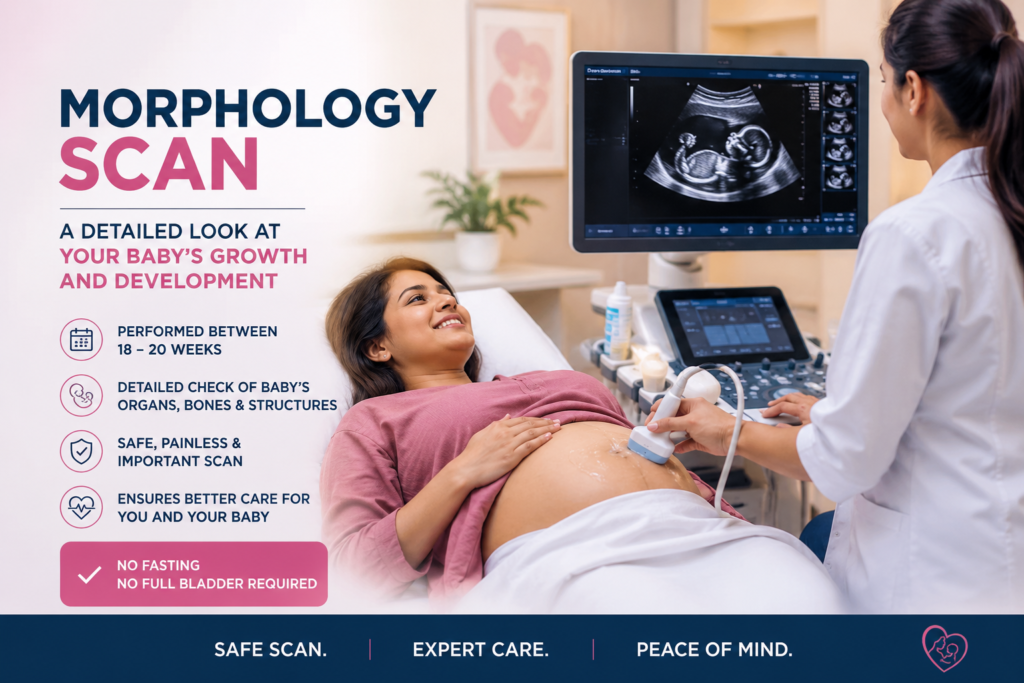
Morphology Scan During Pregnancy: Why Is It Important?
Pregnancy is an exciting journey, and every scan plays an important role in monitoring your baby’s health. Among these, the Morphology Scan is one of the most detailed and informative ultrasound examinations performed during pregnancy.
Usually carried out between 18 and 20 weeks, this scan carefully evaluates your baby’s organs, bones, brain, heart, spine, placenta, and amniotic fluid. It helps doctors ensure that your baby is developing normally while identifying many structural abnormalities early.
The best part? No fasting and no full bladder are required, making the scan comfortable and convenient for expectant mothers.
Watch our video on : Morphology Scan During Pregnancy
What is a Morphology Scan?
A Morphology Scan is a detailed ultrasound examination performed during the second trimester of pregnancy. It is also commonly known as:
Anomaly Scan
TIFFA Scan (Targeted Imaging for Fetal Anomalies)
Level 2 Scan
Mid-Trimester Scan
Unlike routine pregnancy ultrasounds, a Morphology Scan provides a comprehensive assessment of your baby’s anatomy. Every major organ and body part is examined to evaluate normal growth and development.
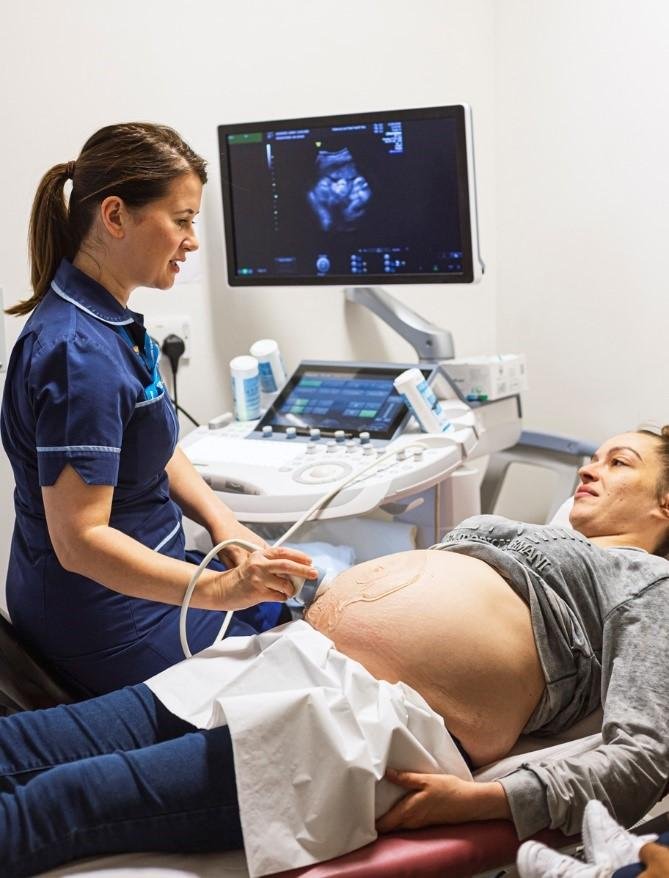
Why is a Morphology Scan Important?
A Morphology Scan is important because it provides a detailed assessment of your baby’s development at a stage when most organs are well formed.
This scan helps doctors:
- Evaluate your baby’s overall growth.
- Examine the development of major organs.
- Detect many structural birth abnormalities.
- Assess the placenta and umbilical cord.
- Measure the amniotic fluid.
- Confirm fetal well-being.
- Plan additional investigations if required.
For most parents, the scan offers reassurance that their baby is developing normally.
What Does a Morphology Scan Check?
During the scan, the sonologist carefully examines multiple parts of your baby’s body.
Baby’s Brain
The baby’s brain is assessed to ensure that its major structures are developing normally.
Baby’s Face
The facial profile, lips, and nose are examined. In many cases, conditions such as cleft lip can be identified.
Baby’s Heart
A detailed evaluation includes:
- Four heart chambers
- Heart valves
- Major blood vessels
- Heart rhythm
- Blood flow
Because the heart is one of the most complex organs, it receives special attention during the scan.
Baby’s Spine
The spine is checked from the neck to the lower back to ensure proper development.
Abdomen
The doctor examines:
- Stomach
- Kidneys
- Bladder
- Abdominal wall
Arms and Legs
The baby’s:
- Hands
- Fingers
- Legs
- Feet
- Long bones
are evaluated to ensure normal development.
Placenta
The scan checks:
- Placenta location
- Placenta appearance
- Placental attachment
Amniotic Fluid
Adequate amniotic fluid is essential for your baby’s healthy growth and movement.
When Should a Morphology Scan Be Done?
A Morphology Scan is ideally performed between 18 and 20 weeks of pregnancy.
Depending on your doctor’s recommendation, it may also be performed between 17 and 22 weeks if clinically indicated.
This period offers the best opportunity to examine your baby’s anatomy in detail.
How to Prepare for a Morphology Scan
Preparing for a Morphology Scan is simple.
No preparation is usually required.
You do not need:
- Fasting
- A full bladder
- Any special diet
You can eat normally before your appointment.
However, remember to bring:
- Doctor’s prescription
- Previous scan reports
- Relevant blood test reports (if advised)
- Valid photo ID
Wear comfortable clothing for the examination.

How Long Does a Morphology Scan Take?
A Morphology Scan generally takes 20 to 45 minutes.
The duration may vary depending on:
- Your baby’s position.
- Baby’s movements.
- Whether additional images are needed.
Sometimes you may be asked to walk for a few minutes or change your position so that better images can be obtained.
Is a Morphology Scan Safe?
A Morphology Scan generally takes 20 to 45 minutes.
The duration may vary depending on:
- Your baby’s position.
- Baby’s movements.
- Whether additional images are needed.
Sometimes you may be asked to walk for a few minutes or change your position so that better images can be obtained.
Can a Morphology Scan Detect Every Problem?
If the scan identifies a concern, your doctor may recommend additional evaluation, such as:
- Repeat ultrasound
- Fetal Echocardiography (Fetal Echo) Genetic counselling
- Additional blood tests
- Consultation with a fetal medicine specialist
Many findings require only monitoring, while others may need further assessment or treatment planning.
What Happens If the Scan Shows an Abnormality?
If the scan identifies a concern, your doctor may recommend additional evaluation, such as:
- Repeat ultrasound
- Fetal Echocardiography (Fetal Echo)
- Genetic counselling
- Additional blood tests
- Consultation with a fetal medicine specialist
Many findings require only monitoring, while others may need further assessment or treatment planning.
Benefits of a Morphology Scan
A Morphology Scan helps:
- Assess your baby’s growth and development.
- Detect many structural abnormalities early.
- Evaluate the placenta and amniotic fluid.
- Monitor fetal well-being.
- Assist doctors in planning pregnancy care.
- Provide reassurance to expectant parents.
Frequently Asked Questions
Is fasting required before a Morphology Scan?
No. You can eat and drink normally before the scan.
Do I need a full bladder?
No. A full bladder is usually not required.
Is the scan painful?
No. It is a painless ultrasound examination.
Can the baby’s gender be revealed during the scan?
No. Under the PCPNDT Act in India, determining or revealing the baby’s gender is strictly prohibited.
How accurate is a Morphology Scan?
It is highly effective in identifying many structural abnormalities, but like any ultrasound, it cannot detect every possible condition.

Founder of Nisarga Diagnostics, is a renowned fetal ultrasound specialist with over 20 years of expertise. An alumnus of Government Medical Colleges in Mysore and Bangalore, he also holds a D.N.B. from the National Board of Examinations, Delhi, and certification from the Fetal Medicine Foundation, London. A former Professor and HOD, he has trained countless PG students and junior radiologists, shaping the future of fetal imaging in India.