

What Does an Anomaly Scan Check? Complete Guide to the TIFFA Scan
Pregnancy is a journey filled with excitement, anticipation, and many important milestones. Among the various tests performed during pregnancy, the anomaly scan, also known as the TIFFA (Targeted Imaging for Fetal Anomalies) scan, is one of the most significant.
This detailed ultrasound examination helps doctors assess your baby’s growth, development, and overall well-being. It is an important step in ensuring that your pregnancy is progressing normally and that your baby is developing as expected.
At Nisarga Diagnostics, Sanjaynagar, Bengaluru, our experienced radiologists perform detailed anomaly scans using advanced ultrasound technology to provide accurate and reliable results.
Watch our video on : What Does an Anomaly Scan Check?
What Is an Anomaly Scan?
An anomaly scan is a specialized ultrasound examination performed during the second trimester of pregnancy. It provides a comprehensive assessment of your baby’s anatomy and helps identify structural abnormalities that may require further evaluation or treatment.
The scan is painless, non-invasive, and completely safe for both the mother and the baby.
When Is an Anomaly Scan Performed?
An anomaly scan is generally performed between 18 and 20 weeks of pregnancy, although it may sometimes be carried out between 18 and 22 weeks, depending on the recommendation of your obstetrician.
At this stage, the baby’s organs have developed sufficiently, allowing the radiologist to obtain detailed images.
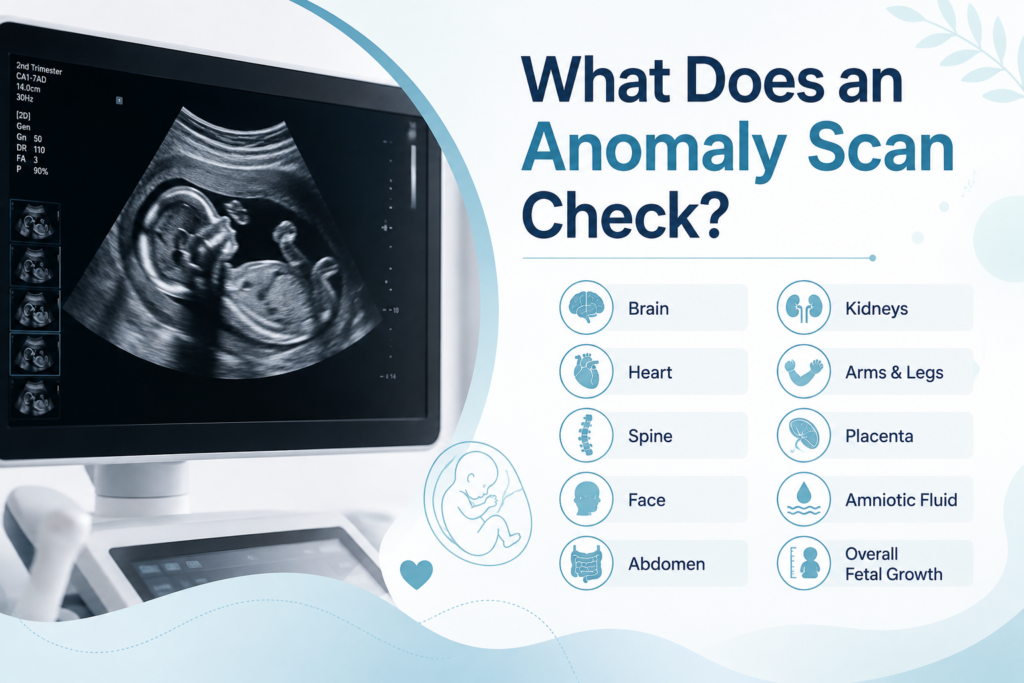
What Does an Anomaly Scan Check?
During the examination, the radiologist carefully evaluates several important structures and organs.
1. Brain and Head
The scan assesses the development of the brain and skull to ensure that the baby’s nervous system is developing normally.
The radiologist examines:
- Brain structures
- Head size and shape
- Cerebral ventricles
- Posterior fossa
2. Face and Neck
The baby’s facial features are examined carefully to identify any visible abnormalities.
The scan evaluates:
- Eyes
- Nose
- Lips
- Jaw structure
- Neck region
3. Heart
The heart is one of the most important organs examined during an anomaly scan.
The radiologist checks:
- Heart chambers
- Heart valves
- Blood flow
- Heart rhythm
- Major blood vessels
In some situations, your doctor may recommend a dedicated fetal echocardiography examination.
4. Spine
The baby’s spine is examined from multiple angles to ensure proper development.
The scan helps identify:
- Alignment abnormalities
- Neural tube defects
- Spinal deformities
5. Abdomen and Internal Organs
Several abdominal structures are assessed, including:
- Stomach
- Liver
- Intestines
- Kidneys
- Urinary bladder
6. Arms, Legs, Hands, and Feet
The radiologist evaluates the baby’s limbs to assess:
- Bone development
- Limb movements
- Hand and foot structure
7. Placenta and Umbilical Cord
The scan also examines structures that support the baby’s growth, including:
- Placental location
- Placental maturity
- Umbilical cord insertion
- Blood circulation
8. Amniotic Fluid
Amniotic fluid plays an essential role in protecting and supporting the developing baby.
The radiologist checks whether the fluid level is within the normal range.
9. Overall Growth and Development
Measurements are taken to evaluate the baby’s growth, including:
- Head circumference
- Abdominal circumference
- Femur length
- Estimated fetal growth
Can an Anomaly Scan Detect Birth Defects?
An anomaly scan can detect many structural abnormalities, including problems involving the brain, spine, heart, kidneys, limbs, and other organs.
However, no ultrasound examination can detect every possible condition. Some abnormalities may be very small or may develop later in pregnancy.
How Should You Prepare for an Anomaly Scan?
Fortunately, very little preparation is required.
You should:
- Carry your doctor’s prescription.
- Bring previous scan reports, if available.
- Carry a valid identification document.
- Wear comfortable clothing.
- Follow any instructions provided by your doctor.
Unlike some early pregnancy scans, fasting is generally not required.
How Long Does an Anomaly Scan Take?
An anomaly scan usually takes approximately 20 to 45 minutes, depending on the baby’s position and the complexity of the examination.
Sometimes, additional images may be required if the baby changes position during the scan.
Why Is an Anomaly Scan Important?
An anomaly scan provides valuable information about your baby’s health and development.
Its benefits include:
- Early detection of structural abnormalities
- Evaluation of fetal growth
- Assessment of the placenta and amniotic fluid
- Better pregnancy planning
- Reassurance and peace of mind for parents
Get Your Anomaly Scan at Nisarga Diagnostics, Bengaluru
At Nisarga Diagnostics, our experienced radiologists provide comprehensive pregnancy imaging services using advanced ultrasound equipment to help ensure accurate diagnosis and timely care.
If you are between 18 and 20 weeks pregnant, speak with your doctor about scheduling an anomaly scan.
Your baby’s health deserves the best possible care from the very beginning.

Founder of Nisarga Diagnostics, is a renowned fetal ultrasound specialist with over 20 years of expertise. An alumnus of Government Medical Colleges in Mysore and Bangalore, he also holds a D.N.B. from the National Board of Examinations, Delhi, and certification from the Fetal Medicine Foundation, London. A former Professor and HOD, he has trained countless PG students and junior radiologists, shaping the future of fetal imaging in India.

